Lite Studio Webclip

Simplify Your Website. Elevate Your Brand.

Schedule a call with our expert web design and answer engine optimization team today to discuss how we can improve search visibility and upscale your brand's online presence in just 30 days.

Schedule Call

AEO Practices for Informational Search Queries

Tom Rezendes
May 13, 2026
By 2026, 83% of Google searches with AI Overviews result in no clicks. Answer Engine Optimization closes that gap by structuring content so AI platforms extract and cite it directly, turning visibility into conversions at 4.4 times the rate of traditional search traffic.

Article Summary

What is Answer Engine Optimization (AEO)?

Answer Engine Optimization is the practice of structuring content so AI systems can easily extract and display it as a direct response to user queries. Unlike traditional SEO, AEO prioritizes clarity, structured data, and answer-first formatting over keyword density and backlink volume.

Why does AEO matter in 2026?

By 2026, 83% of Google searches with AI Overviews result in zero clicks. AEO ensures your content is the source AI platforms rely on, and AI-driven referrals convert at 4.4 times the rate of traditional search traffic, making citation visibility a direct revenue driver.

What is the answer-first approach and why does it work?

The answer-first approach leads each section with a direct, concise response within the first 40 to 60 words before adding supporting detail. Roughly 82% of Perplexity AI responses are drawn from the first 300 words of source content, and declarative structures achieve a 61% AI citation rate compared to 37% for narrative formats.

How does schema markup improve AEO performance?

Schema markup provides machine-readable context that AI systems use to identify authorship, publication dates, and content intent. Pages with schema markup are cited 2 to 3 times more often than those without it, and FAQPage schema alone increases citation rates by 41%.

How often should content be updated for AEO?

Content should be updated meaningfully every 90 days at minimum, with at least 15 to 20% of the content modified each time. Content refreshed within 30 days receives up to six times more AI citations than content over a year old, and visible date stamps and updated schema dateModified fields are both essential signals.
AI search engines prioritize clear, direct answers. If your content isn’t optimized for Answer Engine Optimization (AEO), it risks being overlooked in the growing world of zero-click searches. By 2026, 83% of Google searches with AI Overviews result in no clicks, but AI-driven referrals convert 4.4× better than traditional search traffic.

Key AEO strategies include:

  • Answer-first content: Start with concise answers (40–60 words) before adding details.
  • Structured content: Use headings, short paragraphs, and modular sections for easy AI extraction.
  • Schema markup: Implement FAQPage, Article, and HowTo schema to improve AI visibility.
  • Citations and data: Include verifiable sources and updated statistics every 150–200 words.
  • Regular updates: Refresh content every 90 days with meaningful changes to maintain relevance.

AEO isn’t about replacing SEO - it’s about ensuring your content is the trusted source AI platforms rely on. By focusing on structure, clarity, and credibility, you can position your content as the top choice for AI-driven responses.

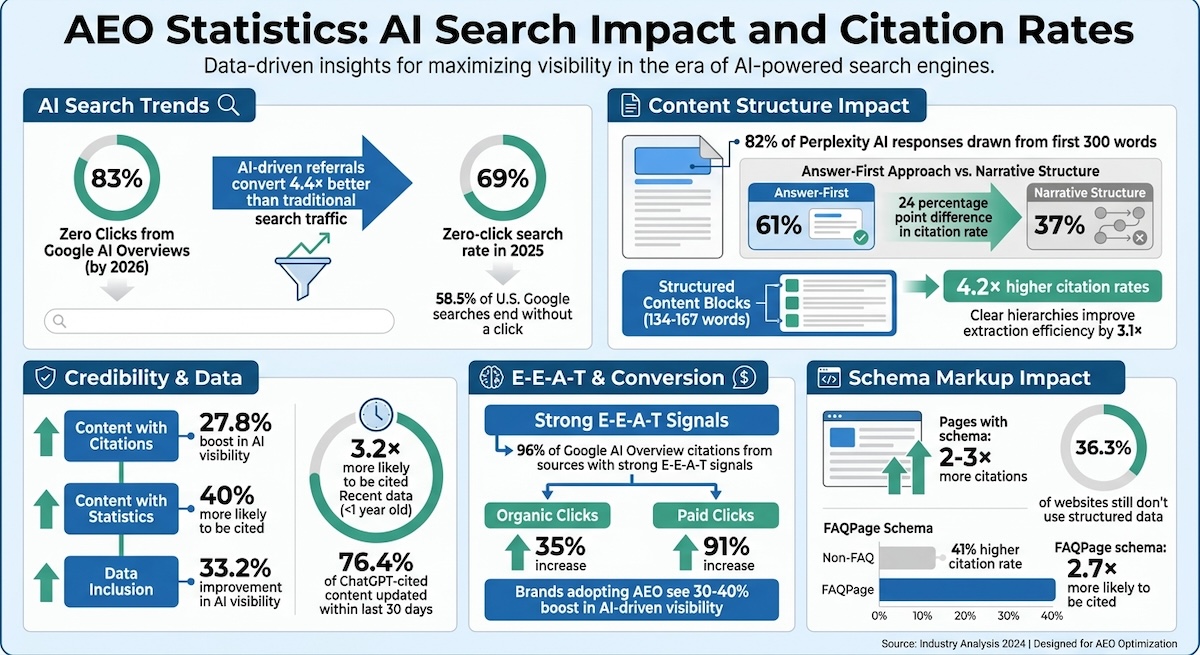
AEO Statistics: AI Search Impact and Citation Rates

Answer Engine Optimization (AEO): How to Rank #1 in AI Overviews & Dominate Search

How to Structure Content for AI-Driven Search Engines

AI systems analyze content differently than humans - they prioritize modular, self-contained sections. This means structuring your content into distinct, standalone blocks can significantly improve its chances of being extracted effectively.

One major shift in content strategy is adopting an answer-first approach instead of building up to a conclusion. Starting each section with a direct, clear statement addressing the topic can increase AI citation rates by 24 percentage points compared to traditional narrative styles [3].

"The single biggest shift in content strategy for AI search is moving from conclusion-last to answer-first writing. If your content builds to a grand reveal, AI models will never reach it." – Marie Haynes, Founder, Marie Haynes Consulting [4]

Answer-First Approach

Roughly 82% of Perplexity AI responses are drawn from the first 300 words of source content. This makes it critical to provide a direct answer within the first 40–60 words of each section [4]. Use the inverted pyramid model: lead with the conclusion, follow with key details, and end with background information. For instance, rather than starting with the history of search engines, begin with:

"Answer Engine Optimization (AEO) is the practice of structuring content so AI systems can easily extract and display it as a direct response to user questions."

Additionally, breaking content into blocks of 134–167 words can increase citation rates by 4.2 times compared to unstructured text [5]. Each block should address a single intent or topic without relying on surrounding context for clarity. Once the main point is established, use precise headings to make it easier for AI to extract information.

Using Clear Hierarchies and Semantic Boundaries

Headings act as guideposts, helping AI systems assess topic depth and expertise. Use H2 and H3 headers phrased as natural language questions, such as "What is AEO?" or "How does voice search work?" This mirrors the way users search online. Maintain a logical structure by following sequential heading levels and keeping paragraphs concise - around 2–5 lines or 3–4 sentences. A clean hierarchy can improve content extraction efficiency by up to 3.1 times [5].

To clarify key ideas, use a "Definition, Attribute, Importance" structure:
"[Entity] is [X]. It includes [Y]. It matters because [Z]."

Formatting for AI Systems

Proper formatting can make your content more accessible for AI-driven queries. Start sections with a "definition-first" format, where a heading is immediately followed by a clear "[Term] is [Definition]" statement. Avoid vague pronouns like "it" or "they" - explicitly name entities, brands, or concepts to enhance clarity and strengthen knowledge graphs.

For how-to guides, use numbered lists with action-oriented verbs, such as "Download", "Install", or "Configure." When comparing options, structured tables work better than lengthy paragraphs, as they allow AI systems to extract precise data quickly. Use semantic HTML tags like <table>, <dl>, and <blockquote> to further reduce ambiguity and improve extractability.

Building Credibility and Authority in Informational Content

AI systems are programmed to minimize uncertainty - they prioritize answers they can verify. Unlike traditional search engines that rely heavily on domain authority and backlinks, AI-driven platforms focus on content with clear trust indicators. To secure citations in AI-generated responses, your content needs to include verifiable sources and structured data.

The best way to achieve this is by establishing entity authority through contributions from recognized experts, trusted brands, and validated information. AI models use a process that aligns content blocks with specific queries. Structured, well-cited sections are more likely to be selected as reliable sources in AI responses. This approach ensures your content not only addresses user questions but also gains AI endorsement.

"AI systems don't just want answers - they want answers they can trace back to authoritative sources. The age of unsourced content marketing is over."
– Rand Fishkin, Co-founder, SparkToro [9]

Citing Authoritative Sources

Citations are more than just formalities - they're trust signals that help AI systems validate the accuracy of your claims. Inline citations that include details like the author, publication, and date can boost AI visibility by 27.8% [9]. Content with explicit references is treated as a credible "node" in a broader knowledge graph, rather than just an isolated opinion.

Whenever possible, cite reputable sources such as .gov, .edu, or peer-reviewed journals. Embed these references directly into your text (e.g., "According to Gartner [6]") to make it easier for AI systems to cross-check facts. This strategy works because AI models often rely on top search results for validation - ChatGPT aligns with Bing's top 10 results 87% of the time, and Google AI Overviews cite top results 93.67% of the time [7].

Citations are just the beginning. Including robust, well-presented data further strengthens your content's credibility.

Including Statistics and Data

Beyond citations, data points act as essential proof for AI validation. Content that incorporates data is 40% more likely to be cited by AI engines compared to opinion-based material [6][8][10]. Adding statistics alone results in a 33.2% improvement in AI visibility [9]. To maximize impact, aim to include a properly attributed statistic or data point every 150–200 words.

Each statistic should be clear and easy to understand. Place the most compelling data point at the beginning of a paragraph to ensure it gets noticed during AI extraction. Use bold formatting to highlight key numbers and create a visual hierarchy that aids AI systems in parsing the content.

Recency is also critical. Data that's less than a year old is 3.2x more likely to be cited by AI systems than older information [10]. In fact, 76.4% of content cited by tools like ChatGPT has been updated within the last 30 days [6].

Creating Original Research and Frameworks

Original research and first-party data hold more weight than third-party statistics. Publishing your own research fosters a "citation authority flywheel", where mentions from industry sources and branded searches make your content a safer choice for AI to cite. Data-rich pages earn over four times as many citations per URL compared to standard directory listings [11].

Original research also creates "proof hooks" - specific sentences with numbers, entities, or constraints that AI models can extract as high-confidence answers. For example, in April 2026, Belkin Marketing used a proof hook: "Across 14 pre-TGE influencer campaigns run between Q2 2024 and Q1 2026, Belkin Marketing observed that mid-tier accounts (10k to 50k followers) generated 41% of total campaign traffic" [12].

When presenting research, keep "story" paragraphs separate from "claim" paragraphs. AI systems often skip sections that mix anecdotes with data. Offering research in multiple formats - like reports, breakdowns, or methodology pages - can address a variety of AI queries. By combining original research with structured citations and data, you solidify your content's position as a trusted authority.

Using Schema Markup for Informational Content

Schema markup works like a translator between your content and AI systems. It clarifies the type of content you’re offering and highlights key details, making it easier for AI to understand and use that information.

While schema markup was traditionally used to secure rich snippets, its role in AI-driven search (AEO) has evolved. Now, it boosts citation rates by signaling content quality directly to AI engines. In fact, pages with schema markup are cited 2–3 times more often than those without it [17]. A study from 2026 found that 36.3% of websites still don’t use structured data, giving a clear edge to those that do [16].

"FAQ Schema is no longer just about winning rich snippets in Google. It has become the single most effective bridge between your content and AI systems."
– Atilla Kuruk, SEO & AI Search Specialist [13]

Adding schema markup also enhances AI systems' ability to extract your content, building on the answer-first format and clear hierarchies discussed earlier.

Types of Schema Markup for Informational Content

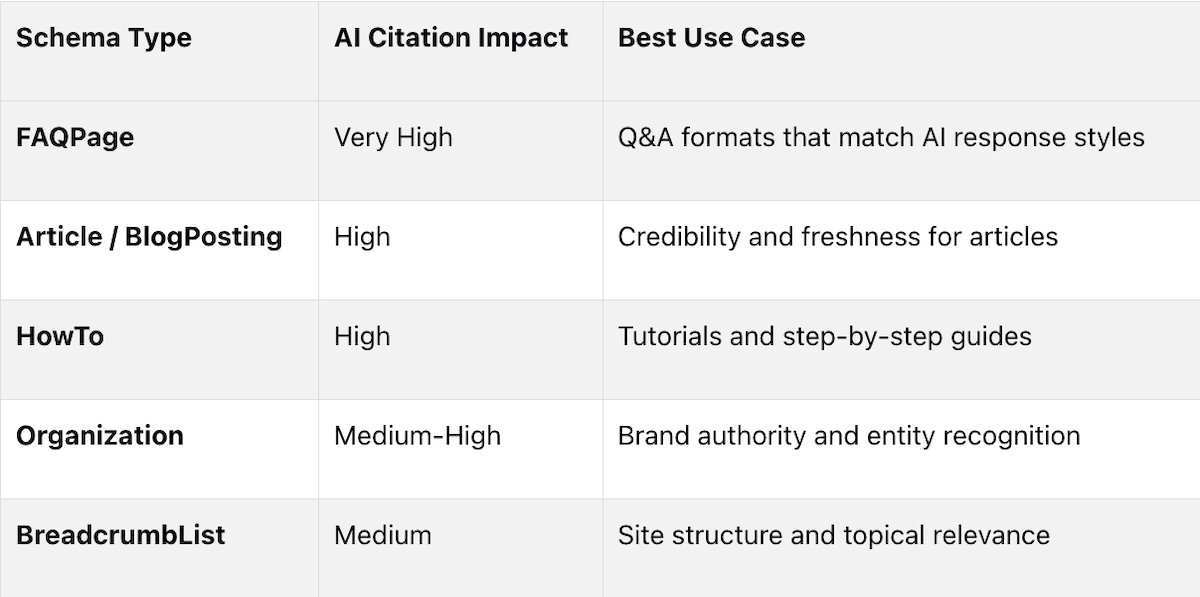
Certain schema types are especially effective for informational content. Here’s how they can help:

  • FAQPage schema: This is one of the most impactful options for informational content. Its question-and-answer format aligns perfectly with how AI systems process information. Pages using FAQPage schema are 2.7 times more likely to be cited and see a 41% higher citation rate [14]. Aim for answers between 50–200 words to balance detail with readability [13].
  • Article schema: This schema, including BlogPosting, establishes your content’s credibility and timeliness. The dateModified field is particularly important, as AI systems prioritize recent updates. Pages updated within the last three months receive nearly twice as many citations from tools like ChatGPT compared to older pages [16]. Strengthen entity recognition by linking the author and publisher fields to verified Person and Organization entities using consistent @id identifiers.
  • HowTo schema: Ideal for step-by-step guides, this schema makes procedural content machine-readable. AI systems can easily extract and reformat these instructions for "how-to" queries.
  • Organization schema: This schema ties your domain to a verified brand identity. Use the sameAs array to link authoritative profiles like LinkedIn, Wikipedia, or Crunchbase, reinforcing your brand’s presence across the web.

These schema types help structure your content in a way that aligns with how AI systems extract and process information.

Implementation Best Practices

To get the most out of schema markup, proper implementation is essential.

  • Use JSON-LD: This format is easier for AI systems to parse. Place the structured data in a <script type="application/ld+json"> tag within the <head> section of your HTML.
  • Ensure consistency: The information in your schema must match what’s visible on the page. AI systems - and Google - may ignore or penalize mismatched or hidden schema.
  • Combine schemas with @graph: Use the @graph pattern to include multiple schema types (e.g., Article, FAQ, Breadcrumb) and define relationships between entities.
  • Validate your schema: Tools like Google’s Rich Results Test and the Schema.org Validator can help ensure your implementation is error-free and eligible for rich results.
  • Scale with templates: For large sites, use templates to apply schema markup consistently across all pages. Include anchor IDs (e.g., #faq, #steps) to allow AI systems to cite specific sections of your content.
"Schema markup does not guarantee AI citations, but it removes classification ambiguity that can cause AI systems to skip your page." – Celestine Abaka, AI Visibility Engineer [15]

Keeping Content Fresh and Topically Relevant

AI systems lean heavily toward recent content. A study of ChatGPT's most-cited pages revealed that 76.4% were updated within the last 30 days, and content refreshed in that window garners up to six times more AI citations than content over a year old [20]. This preference for freshness ensures AI-generated answers remain accurate and up-to-date [23].

The 90-day mark is a key threshold for content updates. However, minor tweaks won’t cut it - updates need to be meaningful, with at least 15–20% of the content modified. This could include adding fresh data, incorporating new examples, or refining the structure [20][23].

"Google also has a binary trust signal when it comes to things like lastmod. So abuse it if you want to lose it." – Mark Williams-Cook, Director, Candour [22]

Regular Updates and Content Refresh

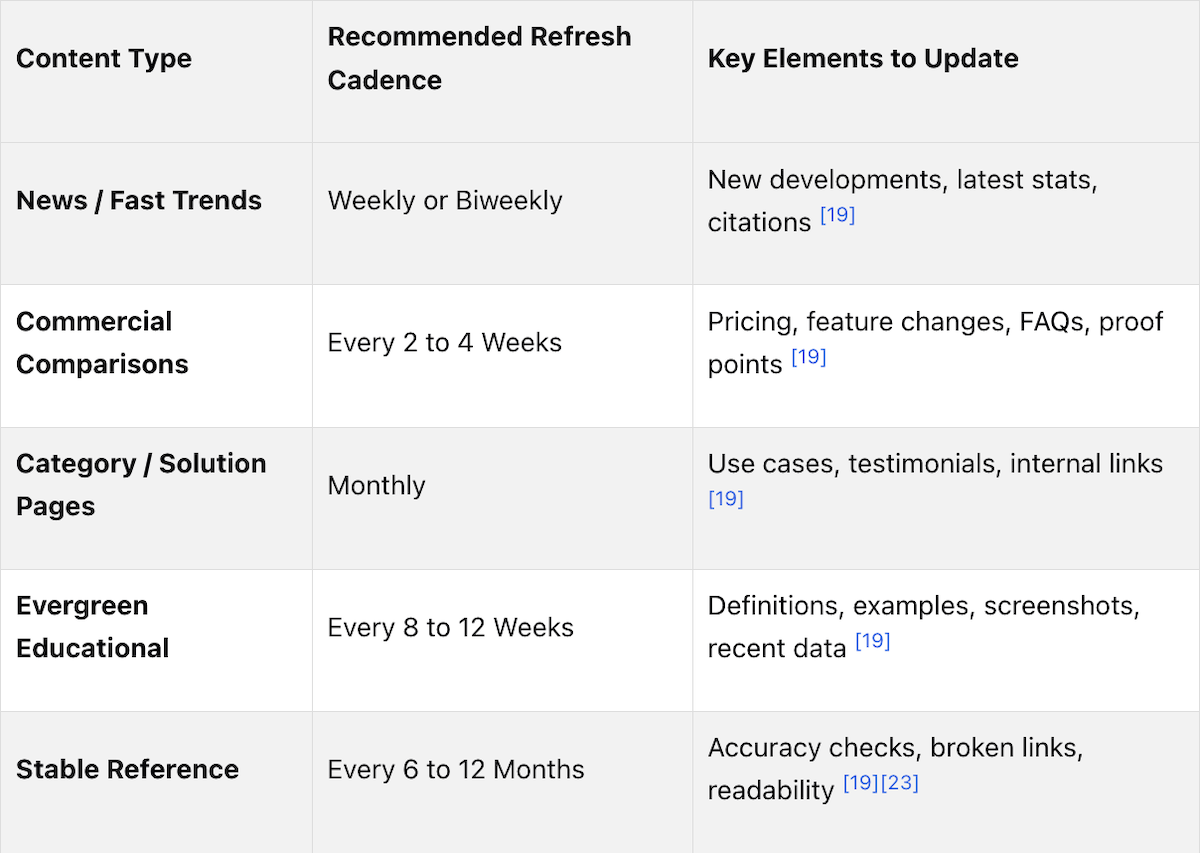
The frequency of updates depends on the type of content and how quickly the information changes. For instance, topics like finance, tech news, or AI tools may need updates weekly or monthly, while evergreen content can be reviewed annually [19][21]. Prioritize the top 20% of your high-performing pages, as these are most at risk of losing ground to competitors [20].

When updating, make sure to adjust the dateModified field in your schema markup and display a visible "Last Updated" date on the page [20][21]. For volatile details like pricing or statistics, use specific phrasing such as "As of May 2026" to improve your chances of being cited in AI-generated answers [21].

Take HubSpot as an example: in September 2025, they updated their "Top Search Engines" blog post, which had been stagnant in search rankings. The overhaul brought in over 10,000 additional monthly organic visits [22]. Similarly, their April 2025 update to the "Competitive Analysis" article tripled its citations in AI responses, jumping from 151 to 476 [22].

Keeping your content fresh not only sustains visibility but also strengthens its connection to related topics, making it more valuable for AI systems.

Building Content Clusters

Regular updates also play a crucial role in maintaining and enhancing content clusters. These clusters help AI systems understand how your expertise is organized around a central topic [27]. A content cluster typically includes a "Pillar Page" that provides a broad overview and "Cluster Pages" that dive into specific subtopics. By interlinking these pages, you create a clear, machine-readable structure that demonstrates depth and authority [25][27].

"In AEO, a topic cluster's primary function shifts from targeting keywords to defining the contextual relationships of a central entity." – SemAI [27]

Clusters address the "Fan-Out Effect", where a single query like "project management software" could cover diverse intents, such as pricing, security, or scalability. Each cluster page can tackle one of these angles, ensuring your content provides comprehensive answers [26]. This approach shifts the focus from sheer volume to creating a web of interconnected, fact-based content that AI systems trust for citations [27].

To optimize cluster articles:

  • Write headings as direct questions (e.g., "How do I create a cluster strategy?") to align with natural language queries [25][26].
  • Begin each article with a 40–60 word summary to offer an immediate, extractable answer for AI systems [26].

Finally, review and update your core educational and category content every 1 to 3 months. This keeps your content competitive and relevant in the evolving world of AI-driven search [19].

Common Mistakes to Avoid in Informational AEO

If you're aiming to make the most of Answer Engine Optimization (AEO) for informational queries, there are several missteps you need to steer clear of. AI systems don't penalize poorly formatted content - they simply skip over it entirely [28]. By understanding these common errors, you can ensure your content is AI-friendly and ready for citation.

Failing to Answer Queries Directly

Long-winded introductions are a major roadblock for AI systems. Instead of diving into the answer, these intros delay the key information, making your content less likely to be cited. Here's a telling statistic: zero-click searches hit 69% in 2025, and searches triggering AI Overviews now show an 83% zero-click rate [29]. This highlights how much AI engines prioritize quick, direct answers.

"A page that buries its answer in paragraph eight after four paragraphs of context preamble will be skipped." – Sunil Pratap Singh, Strategic Search and AI Growth Partner [29]

The numbers back this up. Content that uses a declarative structure (answer first) achieves a 61% citation rate, compared to a 37% citation rate for narrative structures that start with context - a gap of 24 percentage points [3]. AI systems extract specific passages, not entire pages. If your answer isn't in the first 40 to 60 words of a section, it might as well not exist [29][3].

To improve your chances, lead each section with a direct answer. Follow it up with supporting details and context.

Neglecting Schema Markup

Skipping schema markup is another common mistake. AI engines favor content with clear, structured data [31]. Schema markup provides machine-readable context that Large Language Models rely on during retrieval [18]. Without it, AI systems may overlook your content entirely, as they can't confidently identify authorship, publication dates, or intent [18][31].

"If your content isn't machine-readable and entity-clear, you're asking generative engines to guess. They'll cite someone else." – ProseMedia [31]

Schema has evolved from a "nice-to-have" feature into a key extraction signal for AI engines like ChatGPT and Perplexity [2][31]. Start by adding FAQPage, Article, and Organization schema to your most important pages. Ensure your JSON-LD matches the visible content exactly - never mark up hidden text [18][31]. You can also use unique anchor IDs (like #faq or #steps) to help AI link directly to specific sections rather than your homepage [18].

Creating Shallow Content

Thin, surface-level content doesn't stand a chance. AI engines prioritize sources that show consistent expertise across related topics, rather than isolated articles with little depth [28][30]. Content that lacks depth, entity density, or proper structure is far less likely to be cited [29][30].

Instead of focusing on keyword frequency, shift to entity density in 2026 [29]. Use specific terms like "ChatGPT" or "Perplexity AI" instead of vague references. Well-structured content with clear hierarchical headings (H1-H3) is nearly three times more likely to be cited than unstructured text [30]. Additionally, 80% of articles cited by ChatGPT include lists or bullet points, compared to only 28% of top Google search results [30].

Avoid promotional language at all costs. AI systems filter out anything that feels like a sales pitch [28]. Stick to factual, unbiased information, and back it up with specific statistics, examples, and named sources. The goal isn't to write more - it’s to write with clarity and authority that AI systems can trust.

Conclusion

Creating content for informational search queries means rethinking your approach to both structure and strategy. The evolution from traditional SEO to Answer Engine Optimization (AEO) signals a deeper shift in how people access information. With 58.5% of U.S. Google searches now ending without a click [33], your goal should be to craft content that AI engines rely on as a source - not just another ranked page. This approach ensures your content powers AI responses while enhancing your digital presence.

The formula is simple but effective: start each section with a clear, concise answer within the first 40–60 words, back up claims with specific data every 150–200 words, use FAQPage and Article schema through JSON-LD, and keep your content updated regularly. These practices, outlined earlier, will help you stay visible and authoritative in AI-driven search results.

Credibility plays a central role here. Nearly 96% of Google AI Overview citations come from sources with strong E-E-A-T signals [24]. To establish trust, cite authoritative sources, include verifiable data, and maintain a presence on platforms that drive engagement and reviews. AI engines use these signals to confirm expertise before referencing your content [24][32].

The payoff is clear: AI-driven conversions are 4.4× higher, and citations lead to a 35% increase in organic clicks and a 91% increase in paid clicks [24][33]. Brands that have embraced AEO are already seeing a 30–40% boost in AI-driven visibility [1].

"The brands that thrive in the age of answer engines are those that see AEO as an opportunity, not a threat. By becoming the definitive source, you don't just win clicks, you win trust." – Ian Ayliffe, Founder, Panovista Marketing [1]

While SEO remains a cornerstone, incorporating AEO into your strategy amplifies your reach [5]. By treating these methods as complementary, you’ll be ready to lead the next phase of digital discovery. Becoming the go-to source for informational queries doesn’t just improve visibility - it establishes trust and authority that lasts.

FAQs

How do I choose which pages to optimize for AEO first?

Focus on finding pages that align closely with your target queries, hold authority in your niche, and are likely to be referenced by AI-driven answer engines. Start by prioritizing pages that already show strong AI visibility or attract high traffic.

To increase their chances of being chosen by AI systems, ensure these pages are:

  • Well-structured and easy to navigate: A clear layout improves readability and usability for both users and AI.
  • Optimized with question-based headings: Incorporate headings that directly address common questions.
  • Enhanced with FAQ schema: Adding structured data like FAQ schema can boost their relevance for AI-generated answers.

This combination helps position your content as a go-to resource for AI systems.

What does “meaningful” content updating look like every 90 days?

Updating content every 90 days with purposeful improvements is key to keeping it relevant and trustworthy. This process often includes actions like:

  • Refreshing data: Ensuring numbers, dates, and references are up-to-date.
  • Updating statistics: Incorporating the latest figures to reflect current trends.
  • Restructuring for clarity: Adapting content into a question-and-answer format for better readability.
  • Fact-checking: Verifying that all information remains accurate and applicable.

Regular updates like these are especially crucial for industries such as finance, health, tech, legal, and travel. Why? Because these fields rely heavily on accuracy and up-to-date information to maintain credibility, build trust with AI systems, and improve how often they’re cited.

How can I measure whether AEO is improving AI citations and conversions?

To determine whether AEO improves AI citations and conversions, keep an eye on key metrics like citation rate, share of voice, sentiment, position, and conversion quality. Pay attention to how frequently your brand shows up in AI-generated responses and evaluate the quality of leads coming from AI-driven interactions.

Implement attribution models to connect AI citations directly to conversions. Make it a habit to review these metrics every 30 days, allowing you to adjust your AEO strategy for better results.

Key Points

What is Answer Engine Optimization and how does it differ from traditional SEO?

Answer Engine Optimization (AEO) is the practice of structuring content so AI systems can extract and display it as a direct response to user queries. Unlike SEO, which focuses on domain authority and backlinks, AEO prioritizes content structure, credibility signals, and answer-first formatting.

  • AEO targets AI platforms like ChatGPT, Perplexity, and Google AI Overviews, not just traditional search rankings
  • Answer-first formatting means leading each section with a direct response within the first 40 to 60 words, before supporting detail follows
  • Entity clarity matters more than keyword frequency in 2026, using specific named terms like "Perplexity AI" instead of vague references
  • AEO complements SEO rather than replacing it, with AI-driven referrals converting at 4.4 times the rate of traditional search traffic
  • Zero-click searches now represent 83% of queries triggering AI Overviews, making citation visibility a primary traffic and conversion strategy

How should content be structured to maximize AI citation rates?

AI systems analyze content differently than humans, prioritizing modular, self-contained sections that can be extracted independently. Structure is one of the highest-leverage variables in AEO performance.

  • Use the inverted pyramid model: lead with the conclusion, follow with key details, and close with background information
  • Keep content blocks between 134 and 167 words, a range shown to increase citation rates by 4.2 times compared to unstructured text
  • Phrase H2 and H3 headings as natural language questions to mirror how users query AI platforms
  • Use a Definition, Attribute, Importance structure for key concepts: "[Entity] is [X]. It includes [Y]. It matters because [Z]."
  • Maintain clean heading hierarchies with concise paragraphs of 3 to 4 sentences, which improves content extraction efficiency by up to 3.1 times

What schema markup types have the greatest impact on AEO?

Schema markup acts as a translator between content and AI systems, clarifying content type and surfacing key details for extraction. Pages with schema are cited 2 to 3 times more often than those without.

  • FAQPage schema is the highest-impact option for informational content, increasing citation rates by 41% and making pages 2.7 times more likely to be cited
  • Article schema establishes credibility and timeliness, with the dateModified field serving as a critical freshness signal for AI platforms
  • HowTo schema makes procedural content machine-readable and easy for AI to reformat for step-by-step queries
  • Organization schema ties domain content to a verified brand identity, strengthening entity recognition across the web
  • Use JSON-LD format placed in the head section, combine schemas with the @graph pattern, and validate with Google's Rich Results Test before publishing

How do citations and data improve AEO authority?

AI systems are programmed to minimize uncertainty and prioritize answers they can verify. Content with clear citations and embedded data is significantly more likely to be extracted and cited.

  • Content incorporating data is 40% more likely to be cited by AI engines compared to opinion-based material
  • Adding statistics improves AI visibility by 33.2%, and the most compelling data point should lead each paragraph for maximum extraction impact
  • Inline citations with author, publication, and date details boost AI visibility by 27.8% by establishing content as a credible node in a knowledge graph
  • Data less than one year old is 3.2 times more likely to be cited than older information, making recency a direct citation variable
  • Original research creates proof hooks, specific sentences with numbers, entities, or constraints that AI models extract as high-confidence answers

How frequently should content be updated to maintain AEO visibility?

AI systems lean heavily toward recent content, with 76.4% of ChatGPT cited pages updated within the last 30 days. A disciplined refresh cadence is one of the most actionable AEO levers available.

  • Update high-performing pages every 90 days at minimum, with meaningful changes representing at least 15 to 20% of total content
  • News and fast-trend content should be refreshed weekly or biweekly with new developments, statistics, and citations
  • Evergreen educational content can follow an 8 to 12 week refresh cycle focused on definitions, examples, and recent data
  • Always update the dateModified field in schema and display a visible Last Updated date on the page after any refresh
  • Use phrasing like "As of May 2026" for volatile details such as pricing or statistics to strengthen AI citation eligibility

What content cluster strategy best supports AEO performance?

Content clusters help AI systems understand how expertise is organized around a central topic, shifting the primary function of clusters from keyword targeting to defining contextual relationships between entities.

  • Build a Pillar Page that provides a broad overview of the central topic, supported by Cluster Pages that address specific subtopics in depth
  • Interlink cluster pages to create a machine-readable structure that demonstrates topical depth and authority to AI systems
  • Each cluster page should address a single search intent, tackling one angle of the Fan-Out Effect such as pricing, security, or scalability
  • Begin every cluster article with a 40 to 60 word summary to provide an immediately extractable answer for AI platforms
  • Write headings as direct questions throughout the cluster to align with natural language queries and improve citation eligibility across the entire content network

Get Started

Streamline your online presence and captivate users with a refined, single or minimal page experience. Schedule a call with our team today to discuss how we can simplify your site and elevate your brand in just 30 days.

Schedule Call