

Article Summary
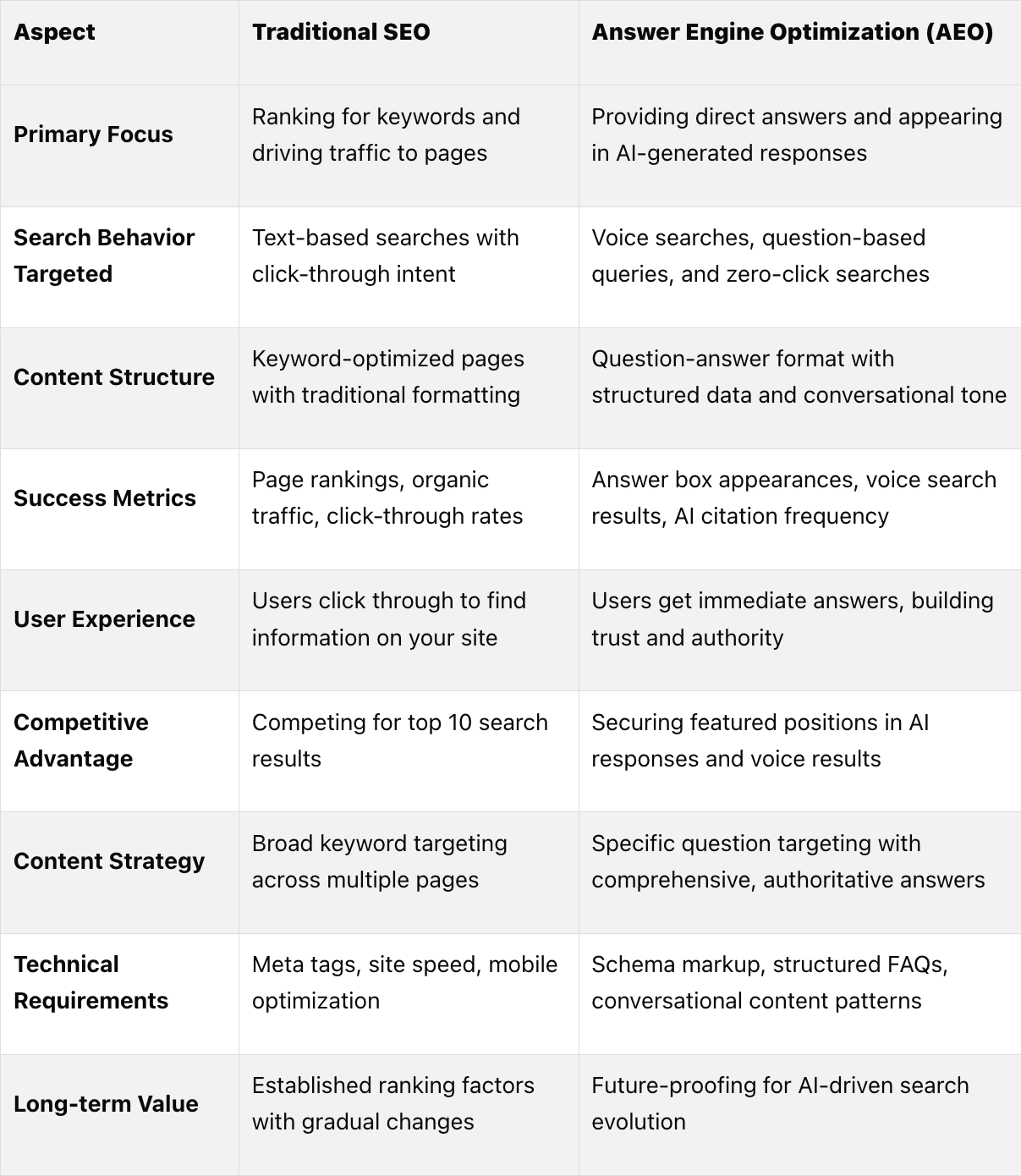
AEO focuses on creating content that AI systems like ChatGPT, Siri, and Alexa can use to directly answer user questions. Unlike traditional SEO, which aims to rank entire web pages, AEO structures content for quick, conversational responses that AI can extract and cite. AEO prioritizes direct answers, natural language queries, and voice search optimization, while SEO focuses on keyword rankings and website traffic.
Effective AEO implementation requires three key technical components: 1) Schema markup and structured data (FAQPage, HowTo, QAPage schemas) to help AI systems understand content structure, 2) Content formatted in question-and-answer style with clear headings and bullet points for easy extraction, and 3) Voice search optimization using conversational language and natural speech patterns instead of keyword-heavy text.
AEO works best for local businesses needing immediate visibility (restaurants, retail stores), how-to and instructional content that can be read aloud by voice assistants, FAQ-style content answering common questions, mobile-first audiences who prefer quick spoken answers, and time-sensitive queries about weather, hours, or locations. Traditional SEO remains better for complex research topics and B2B content.
Answer engines follow a three-step process: 1) Query Analysis - breaking down user questions to understand intent and context, 2) Information Retrieval and Synthesis - gathering data from multiple credible sources and combining insights, and 3) Response Generation - creating natural language replies with direct answers followed by supporting details. Systems use transformer architecture and semantic understanding to interpret conversational queries beyond simple keyword matching.
Professional AEO services typically start at $2,000+ due to the specialized technical and strategic expertise required. Services include proprietary AEO techniques, AI-driven search visibility optimization, voice search optimization, schema markup implementation, mobile optimization, fast load speed optimization, and often integration with website development and UX research for comprehensive optimization.