Lite Studio Webclip

Simplify Your Website. Elevate Your Brand.

Schedule a call with our expert web design and answer engine optimization team today to discuss how we can improve search visibility and upscale your brand's online presence in just 30 days.

Schedule Call

Best Practices for Generative Search Optimization

Matt Clark
January 27, 2026
AI-driven search is rewriting the rules of online visibility. As traditional search declines and AI-generated answers dominate, business owners face a new challenge: ensuring their content is cited, trusted, and found by intelligent engines like ChatGPT and Google AI Overviews. Lite Studio’s Generative Engine Optimization (GEO) empowers you to secure top AI citations and authority. Discover how structured, data-driven content and expert schema implementation can future-proof your brand’s online presence. Learn actionable best practices that blend Lite Studio’s expertise with proven strategies to maximize your visibility in AI-powered search results.

Article Summary

How is generative search changing the way my business gets found online?

Generative search, powered by AI tools like ChatGPT and Google AI Overviews, is shifting discovery from traditional search results to AI-generated answers, meaning your content must be structured for direct citation to maintain and grow visibility.

What are the top factors that help my website get cited by AI search engines?

The most important factors are semantic relevance (30–40%), source authority (25–35%), and content structure (15–20%). Using schema markup and keeping content fresh can double your chances of being cited by AI tools.

How can I make my content more likely to be cited by AI tools like ChatGPT?

Focus on clear, structured, and factual content with direct answers, question-based headings, and reliable data. Implementing schema markup and modular content design significantly boosts AI citation rates.

Why does schema markup matter for AI search visibility?

Schema markup, especially in JSON-LD format, makes your content machine-readable, increasing the likelihood of being cited by AI by up to 2.3 times compared to unstructured content.

What is E-E-A-T and why is it important for generative search optimization?

E-E-A-T stands for Experience, Expertise, Authoritativeness, and Trustworthiness. Demonstrating these qualities with solid data and human authorship signals helps AI engines trust and cite your content more often.

Want your content cited by AI tools like ChatGPT or Google's AI Overviews? Generative Search Optimization (GEO) is how you make it happen. Unlike traditional SEO, GEO focuses on structuring your content to be referenced in AI-generated answers. Here's what you need to know:

  • AI search tools rely on Retrieval-Augmented Generation (RAG) to extract and synthesize information from multiple sources.
  • The average AI search query is 23 words long, far more specific than traditional 4-word searches.
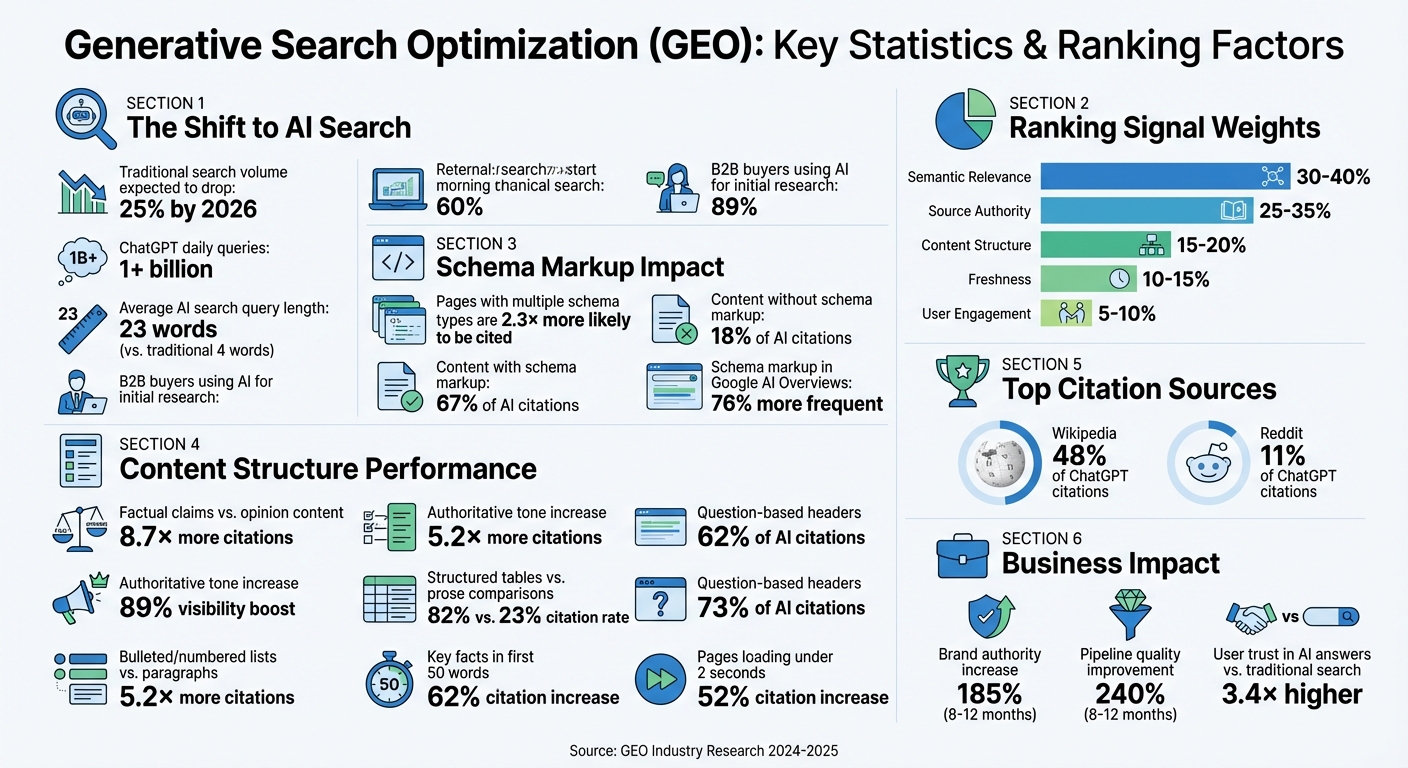
  • Key ranking factors include semantic relevance (30–40%), source authority (25–35%), and content structure (15–20%).
  • Using schema markup boosts your chances of being cited by up to 2.3×, and modular, self-contained content performs better.

Why it matters: Search habits are shifting. By 2026, traditional search volume is expected to drop 25%, while tools like ChatGPT handle over 1 billion daily queries. If your content isn't optimized for AI, you risk losing visibility.

The solution: Focus on clear, structured, and factual content. Use interrogative headers, concise paragraphs, and schema markup. Update your content regularly and ensure it's easy for AI systems to extract key insights.

Bottom line: GEO is the future of search visibility. Start preparing now to stay ahead as AI platforms dominate how users discover information.

Generative Search Optimization Key Statistics and Ranking Factors

Core Principles of Generative Search Optimization

How LLM-Based Answer Engines Work

AI search engines, like ChatGPT, operate using a Retrieval-Augmented Generation (RAG) pipeline, which is quite different from traditional search indexing. Instead of merely matching keywords, these systems go through a four-step process to deliver answers [5][2].

First, the engine interprets your query to uncover the intent and pinpoint key entities. Then, it retrieves potential documents from across the web. Next comes the passage extraction phase, where the AI evaluates chunks of content (typically 128–512 tokens) based on their relevance, factual accuracy, and ability to stand alone [5]. Finally, the engine synthesizes these passages into a cohesive answer and decides which sources to cite.

Unlike traditional search engines, this process breaks content into semantic passages, each scored individually for relevance and self-containment. This means that even well-optimized pages might lose visibility if their key information is scattered [5]. This segmentation forms the basis for the ranking signals discussed below.

Ranking Signals for Generative Search

AI search engines rely on several signals to determine which sources to cite. Semantic relevance is the most important, accounting for 30–40% of the decision-making process. This is measured through embedding similarity and entity overlap [5]. Source authority follows closely at 25–35%, with factors like domain trust, backlink profiles, and author credentials playing a major role [5].

Content structure contributes 15–20% to the ranking. AI tools prefer well-organized content with clear headers, lists, and logically structured passages [5]. Freshness makes up another 10–15%, with recent publication dates and updated content being favored [5]. Finally, user engagement signals, when available, account for the remaining 5–10% [5].

Interestingly, pages that use multiple schema types are 2.3 times more likely to be cited than those relying on a single schema [5]. Additionally, 67% of AI citations come from content with schema markup, compared to just 18% from unmarked pages [10].

Aligning Content with Relevance and Trust

To increase the likelihood of being cited by AI engines, your content needs to be both relevant and credible. Content that includes clear, factual claims is cited 8.7 times more often than opinion-heavy material [10].

Establishing E-E-A-T - Experience, Expertise, Authoritativeness, and Trustworthiness - is essential for AI citations. Models actively look for author credentials, verified claims, and consistent entity naming throughout your content [5][2]. A study by Princeton revealed that rewriting passages with an authoritative tone increased AI visibility by 89% [1].

"The more proof of a human author, rather than AI, the better. Domain authority becomes even more important as well."
– Baird Hall, Digital Marketing Expert [9]

To boost your content's AI citation potential, ground your claims in solid data and include expert quotes. Write in concise, self-contained paragraphs (around 200 words) to ensure coherence when segmented [5]. Use assertive and confident language, avoiding vague terms like "might" or "possibly" [1]. Inline citations to reputable sources can further enhance your visibility by 30–40% [1][8].

Generative Engine Optimization Strategy & Tactics [Deep Dive]

Data and Signals for Generative Search Ranking

This section delves into how data and content structure influence ranking decisions, building on core GEO principles.

Key Data Sources for GEO

Generative engines rely on a Retrieval-Augmented Generation (RAG) process, combining internal training data with external sources like dense vector search, sparse retrieval, and structured queries against knowledge graphs [5][3].

Knowledge graphs play a central role here. These systems focus on clearly defined entities - brands, people, products - and their relationships. High-authority nodes within these graphs are more likely to be cited. For example, Wikipedia makes up 48% of ChatGPT's top citations, while Reddit accounts for 11%, underscoring the reliance on specific, trusted datasets [4][5][10].

User interaction signals, which contribute roughly 5–10%, and training through Reinforcement Learning from Human Feedback (RLHF) further refine model priorities [5][1].

How Structured Data Improves GEO

Structured data, such as JSON-LD schema markup, labels content as specific entities - like recipes, products, or FAQs - helping AI systems during passage extraction [1][5].

Its impact is clear: schema markup significantly boosts citation likelihood. Pages utilizing multiple schema types are cited 2.3 times more often than those using just one [5][10]. Additionally, content with schema markup appears 76% more frequently in Google AI Overviews [10].

Key schema types to focus on include FAQPage, HowTo, Product, and Article. These formats make it easier for AI systems to extract concise, meaningful snippets [6]. For instance, structured tables are cited in 82% of relevant AI responses, compared to just 23% for prose-based comparisons [10].

Content Design as a Ranking Signal

The structure of your content plays a pivotal role in AI citation. Elements like interrogative headings, bulleted lists, and front-loaded numerical data (within the first 50 words) can increase citation rates by 4–5 times [10]. This aligns with how users phrase natural language queries in generative search tools, which average 23 words - far longer than the typical 4-word Google query [2].

Bulleted or numbered lists are especially effective, earning 5.2× more citations than unstructured paragraphs [10]. To optimize for AI, aim for self-contained paragraphs of 300–500 words. These can be easily "chunked" by AI crawlers into 128–512 token blocks [5][10].

"In the past 6 months... we've noticed how AI-driven search tends to pull in content that's extremely structured via bulleted lists, structured headings, and general listicle-style articles." – Chris Long, VP of Marketing, Go Fish Digital [2]

Best Practices for Designing Generative Ranking Systems

When it comes to generative ranking systems, achieving the right balance of relevance, trust, and freshness is key. These systems thrive on structured content signals, creating a framework where relevance, credibility, and timeliness come together to improve AI citation performance.

Optimizing Relevance and Retrieval

Generative systems rely on a combination of dense vector search for semantic understanding and BM25 for precise keyword matching [5]. Together, these methods ensure that AI captures both the broader context and the exact terms users are searching for.

The real magic happens at the passage level. Content is broken into smaller chunks, typically 128–512 tokens, and each block is scored for relevance concentration, self-containment, and factual density [5]. Pages structured with modular, stand-alone sections perform better because AI can extract information without losing context [7][5].

Here’s a tip: presenting an authoritative tone can increase visibility by 89% [1]. Additionally, placing key facts within the first 50 words of a section boosts citation rates by 62% [10]. This strategy signals immediate relevance, helping retrieval models identify and extract answers more effectively.

Maintaining Trust and Quality in Generative Search

Trust signals play a big role, contributing 25–35% of the total ranking weight in generative systems [5]. High-authority sources are prioritized through several verification layers, including domain trust scores, backlink profiles, schema completeness, and author credentials.

Want to improve your content’s trustworthiness? Use an assertive tone and include inline citations from reputable sources like the World Health Organization or recognized industry leaders. This approach can increase AI quality scoring by up to 30% [1]. Even for sites that don’t rank at the top, this strategy can lead to a 115% boost in visibility within AI-generated results [9].

Interestingly, users trust AI-generated answers 3.4 times more than traditional search results [10]. This means accuracy and verifiability are more important than ever. Implementing JSON-LD schema markup for Article, FAQPage, and Organization types provides machine-readable trust signals, helping AI validate your content during retrieval [1][11].

Using Freshness and Temporal Signals

Freshness accounts for 10–15% of the ranking weight in most generative systems, but this percentage jumps significantly for queries with temporal intent, such as "2025 trends" or "current best practices" [5]. On platforms like Perplexity, content published within the last 90 days is 40% more likely to be cited than older material [5].

To keep your content fresh, mark updates clearly with "last-updated" dates and use datePublished and dateModified schema markup [7][5]. Resubmitting updated pages through Search Console can also prompt faster AI recrawling [7][11].

For enterprise sites managing large volumes of content, a quarterly refresh cycle works well for high-value pages. Instead of overhauling entire articles, focus on updating specific "answer nuggets" or Q&A sections with the latest statistics and examples [7][11]. This modular update strategy keeps the most extractable parts of your content current while preserving the structure that AI systems have already indexed.

"Freshness weight increases for queries with temporal intent ('2025 trends,' 'current best practices') and decreases for evergreen topics ('how photosynthesis works')."
– Agenxus [5]

Content and Experience Design for Generative Search Optimization

Structuring your content effectively is just one part of the equation. The other crucial aspect is ensuring that AI systems can easily extract and reference your material. Let’s explore how to design both your content and user experience to enhance visibility in generative search results.

Structuring Content for Generative Ranking

Think of your content as a collection of self-contained, modular blocks. Each section should stand on its own, with clear header tags (H2, H3) serving as logical boundaries [5][12]. Using interrogative headers - such as "How do I optimize for generative search?" - can align your content with user queries. Interestingly, 73% of AI citations come from sections that use question-based headers [10].

Focus on one primary entity per page and connect it to 3–6 related entities, such as concepts, brands, or individuals [7]. This creates a topical graph that AI systems can explore and validate. To further assist AI, implement an llms.txt file at your domain root, providing a structured roadmap for large language model (LLM) crawlers [7].

Performance matters, too. Pages that load in under two seconds see a 52% increase in citation rates [10]. A mobile-first design is also essential; keep URLs concise (under 60 characters) and ensure your site architecture is clean and logical [10]. This modular setup not only improves user experience but also makes your content more accessible for AI-driven systems.

Creating Citation-Ready Content

Once your modular structure is in place, focus on making your content easy for AI to extract. Start each page or section with a "Quick Answer" block of 40–80 words that directly addresses the main query before diving into detailed explanations [4][7]. This approach significantly increases your chances of being cited.

Data-driven content is particularly effective. Including quantifiable information within the first 50 words can boost citation likelihood by 62% [10]. Aim for at least six concise, self-contained answers (1–3 sentences each) for every 1,000 words [7]. These "answer nuggets" make it easier for AI to extract and attribute your insights.

Visual elements like comparison tables are another powerful tool. Well-structured tables are cited in 82% of relevant AI responses, compared to just 23% for prose-based comparisons [10]. Similarly, bulleted or numbered lists are 5.2 times more likely to be cited than plain paragraphs [10].

Your tone matters, too. Writing with authority and confidence - avoiding hedging phrases like "might" or "could" - can increase visibility by 89% [1]. Adding inline citations to reputable sources, such as the World Health Organization or industry leaders, can further improve AI quality scoring by 30% to 40% [1].

"AI systems reward clarity over keyword density. The key is reformatting your pages to improve 'extractability.'" – Nathan Smith, Directive [7]

How Lite Studio Simplifies Complex Websites

Large enterprise websites often struggle with an overload of content and a lack of structure. This can confuse both users and AI systems, making it harder for generative engines to extract clean, citable information.

Lite Studio specializes in turning sprawling enterprise sites into streamlined, user-friendly designs optimized for both human engagement and AI visibility. Their services combine generative engine optimization (GEO) strategies with data-driven UX research to create websites that excel in the era of generative search. Starting at $2,000 for answer engine optimization and $3,000 for comprehensive website design, Lite Studio focuses on mobile optimization, fast load times, and modular content structures that AI can easily parse and cite.

Their approach integrates GEO into every aspect of their work, using tools like Webflow and Framer to prioritize clean URL structures, logical header hierarchies, and passage-level optimization. For enterprises managing thousands of pages, this methodical approach to content architecture can be the difference between being overlooked by AI and becoming a go-to cited source. By following these principles, Lite Studio ensures that websites are not only user-friendly but also primed for generative search success, aligning perfectly with the strategies outlined above.

Conclusion and Key Takeaways

The era of generative AI platforms is no longer on the horizon - it’s happening right now. With ChatGPT handling over 1 billion queries daily and Google AI Overviews showing up in more than half of searches [4], businesses can’t afford to overlook the importance of generative search optimization. The game has changed: success now hinges on being cited and synthesized within AI-generated answers, rather than just ranking among blue links [2][5]. The strategies outlined earlier are designed to help enterprises adapt to this shift.

Companies that have embraced Generative Experience Optimization (GEO) have seen impressive results - brand authority has increased by 185%, and pipeline quality has improved by 240% within 8–12 months. Meanwhile, 89% of B2B buyers now rely on AI platforms like ChatGPT for their initial research [4]. These numbers highlight the urgency of acting now and implementing a focused strategy.

The approach itself is simple but effective: craft modular, citation-ready content with clear structures and reliable sources. Use comprehensive schema markup and ensure your technical setup allows AI crawlers to access your content effortlessly. Structure answers upfront, incorporate question-based headers, and update content regularly to keep it relevant. Focus on making your content easy to extract - AI platforms prioritize clarity and factual accuracy over outdated keyword-stuffing tactics [1][5].

Expert opinions emphasize the importance of this shift:

"If you're not part of the AI answer, you're not part of the deal." – Samanyou Garg, Founder & CEO, Writesonic [13]

And as Nathan Smith, SEO Strategist at Directive, explains:

"SEO is a long game, you can see improvements in as quick as 3 months but the real value compounds over years" [7].

The takeaway? Start building your presence in AI-generated answers now, because the competition for these coveted citations is only going to get tougher.

Final Thoughts on Generative Search Optimization

Generative search optimization is reshaping how people find and interact with information. The structured data strategies and best practices shared earlier aren’t just helpful - they’re essential. Businesses that want to stay relevant must go beyond surface-level tweaks and commit to creating structured, reliable, and easily extractable content designed with AI in mind.

The early adopters of GEO have a clear advantage. With traditional search volume expected to drop by 25% by 2026 [4], companies that act now can secure a strong “share of voice” in AI responses before the space becomes overcrowded. This window of opportunity is closing fast, and as more businesses recognize the value of AI citations, the competition will only heat up.

While technical optimizations are critical, don’t lose sight of the bigger picture: creating genuine value. Implement the structured data, modular content, and technical foundations outlined in this guide, but remember that AI platforms, like human audiences, reward content that delivers unique, meaningful information that meets user needs [14]. Technology may evolve, but the mission remains the same - be the most trusted and authoritative source in your field. Do that, and both AI systems and your audience will take notice. Together, these strategies highlight the enduring importance of clear, authoritative content in the AI-driven world.

FAQs

How does schema markup help AI generate accurate citations?

Schema markup uses structured data to present your website’s content in a way that's easier for AI models to interpret. By formatting critical information into a machine-readable structure, schema markup helps AI better recognize and validate the facts on your site. This increases the chances of your content being referenced in AI-generated answers.

By taking this organized approach, you enhance the credibility of your content, making it more likely that AI systems will rely on your site when crafting responses for users.

What sets Generative Search Optimization (GEO) apart from traditional SEO?

Traditional SEO is all about improving a website's position on search engine results pages (SERPs). This involves optimizing keywords, building backlinks, refining meta tags, and boosting page authority. The ultimate goal? Driving more organic traffic and increasing click-through rates by climbing higher in rankings for specific search queries.

Generative Search Optimization (GEO) works differently. It's tailored for AI-powered answer engines like ChatGPT and Google’s AI Overviews. Instead of focusing on link rankings, GEO emphasizes creating conversational, intent-driven content that directly addresses user questions. It also ensures content is formatted for AI extractability and citation, using tools like schema markup and entity mapping to establish credibility and improve visibility in AI-generated responses. While traditional SEO aims for clicks, GEO prioritizes zero-click visibility, ensuring your content is cited even if users don’t visit your site.

Lite Studio helps businesses navigate this shift by crafting AI-optimized content and implementing structured data strategies, all while keeping traditional SEO principles intact.

Why does keeping content fresh matter for AI-driven search rankings?

Keeping your content updated is crucial for staying visible in AI-powered search results. When you refresh your material, it signals to AI systems that your information is current and relevant, boosting the likelihood of being included in AI-generated answers.

Consistently revisiting and updating your content doesn’t just help maintain search rankings - it also ensures your audience gets accurate, timely information. This approach strengthens engagement and builds trust with your users.

Key Points

What are the core ranking signals for generative search, and how do they differ from traditional SEO?

  • Semantic relevance is the top ranking factor for generative search, accounting for 30–40% of AI citation decisions. This means your content must directly and clearly answer the specific intent behind user queries, not just include keywords.
  • Source authority is weighted at 25–35%. AI engines prioritize content from domains with established expertise, trustworthiness, and a proven track record of accuracy.
  • Content structure contributes 15–20% to ranking. Well-organized, modular content with clear headings, bullet points, and concise paragraphs is favored by AI for easy passage extraction.
  • Freshness and user engagement are also considered. Regularly updated content and high engagement metrics (like time on page) signal ongoing relevance to AI systems.
  • Unlike traditional SEO, which focuses on backlinks and keyword density, generative search optimization (GEO) emphasizes factual accuracy, structure, and machine-readability. Lite Studio’s approach integrates these factors to maximize AI citation potential.

How does Retrieval-Augmented Generation (RAG) shape content discovery and citation by AI tools?

  • RAG is the process by which AI search engines interpret queries, retrieve relevant documents, extract key passages, and synthesize answers. This multi-step approach means content must be easily segmentable and contextually rich.
  • AI breaks content into semantic passages, not just pages. Each paragraph or section should be self-contained and answer-focused to increase the likelihood of being cited.
  • Passage extraction is influenced by schema markup and logical content hierarchy. Using JSON-LD schema and clear H1 → H2 → H3 structures helps AI engines identify and extract the most relevant information.
  • Lite Studio designs content frameworks specifically for RAG compatibility, ensuring your business’s expertise is surfaced and cited by leading AI platforms.

Why is schema markup critical for generative engine optimization, and which types are most effective?

  • Schema markup, especially in JSON-LD format, makes your content machine-readable and increases the likelihood of AI citation by up to 2.3×.
  • Multiple schema types (e.g., FAQPage, HowTo, Article) further boost citation rates. Pages using more than one schema type are 2.3 times more likely to be cited by AI tools.
  • FAQ Page and HowTo schemas are particularly effective for business content, as they align with common user queries and AI extraction patterns.
  • Lite Studio implements and validates advanced schema strategies, ensuring your content is optimized for both traditional and generative search engines'.

How can business owners establish E-E-A-T (Experience, Expertise, Authoritativeness, Trustworthiness) for AI-driven search?

  • AI engines heavily weigh E-E-A-T signals when selecting sources to cite. Demonstrating real-world experience, subject matter expertise, and transparent authorship is essential.
  • Cite specific data, statistics, and primary sources to reinforce trustworthiness. Content grounded in verifiable facts is more likely to be referenced by AI.
  • Showcase author credentials and company authority. Including bios, case studies, and client testimonials strengthens your perceived expertise.
  • Lite Studio’s content frameworks are designed to surface E-E-A-T signals, positioning your business as a trusted authority in your field.

What content design strategies maximize the chances of being cited by AI answer engines?

  • Use interrogative (question-based) headings and direct-answer formatting. AI models prefer content that mirrors natural language queries and provides clear, concise answers upfront.
  • Break content into modular, self-contained sections. Each passage should be able to stand alone, increasing the odds of being selected for citation.
  • Incorporate bullet lists, tables, and short paragraphs (100–300 words) to enhance scannability and passage extraction. These elements help AI engines quickly identify and extract relevant information.
  • Lite Studio specializes in modular content design, ensuring your business’s expertise is easily discoverable and cited by AI tools.

How should businesses adapt their content strategy as generative search becomes dominant by 2026?

  • By 2026, traditional search volume is projected to decline as AI-driven discovery becomes the norm. Businesses must shift from keyword-centric SEO to GEO, focusing on structured, factual, and citation-ready content.
  • Regularly update and expand content to maintain freshness and relevance. AI engines favor up-to-date information and ongoing engagement.
  • Monitor AI citation analytics and adjust strategies based on performance. Tracking which passages are cited helps refine future content for maximum impact.
  • Lite Studio offers ongoing optimization and reporting, helping businesses stay ahead as generative search reshapes the digital landscape.

Get Started

Streamline your online presence and captivate users with a refined, single or minimal page experience. Schedule a call with our team today to discuss how we can simplify your site and elevate your brand in just 30 days.

Schedule Call