
Lite Studio Webclip

Simplify Your Website. Elevate Your Brand.

Schedule a call with our expert web design and answer engine optimization team today to discuss how we can improve search visibility and upscale your brand's online presence in just 30 days.

Schedule Call

Content Structuring for Generative Search

Matt Clark
January 13, 2026
Lite Studio's proprietary Answer Engine Optimization (AEO) approach transforms how your content performs in AI-driven search environments. Our proven methodology—featuring direct-answer formatting, question-based headings, and strategic schema implementation—has delivered visibility increases of up to 89% for authoritative content and citation boosts of 40% through data-driven optimization.

Article Summary

How is AI search affecting my website traffic?

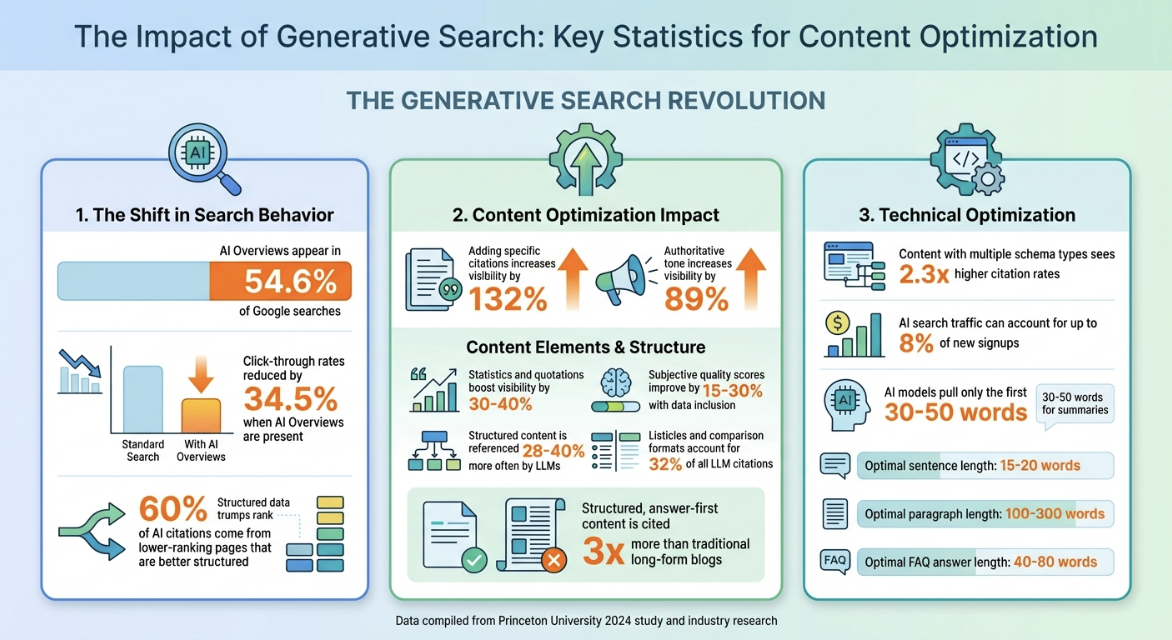
AI Overviews now appear in 54.6% of Google searches, reducing traditional click-through rates by 34.5%. However, businesses that adapt their content strategy can capture up to 8% of new signups from AI search traffic. Lite Studio's AEO approach helps companies turn this challenge into a competitive advantage.

What is Answer Engine Optimization (AEO) and why do I need it?

AEO is the practice of optimizing content to be cited and referenced by AI search engines like ChatGPT, Google AI, and Bing Copilot. Unlike traditional SEO that focuses on rankings, AEO ensures your business becomes the authoritative source AI systems trust and quote. This shift is essential as search behavior moves from clicking links to consuming AI-generated summaries.

How can I make my content visible in AI search results?

Focus on three key strategies: place direct answers at the beginning of each section, use question-based headings that mirror natural queries, and implement structured data markup. Research shows that authoritative, data-backed content with clear formatting can increase AI citation visibility by up to 89%. Lite Studio specializes in these technical implementations for maximum impact.

What are the most important changes I need to make to my content?

Start with 'answer-first' formatting—put key insights in your first 1-2 sentences since AI models often pull only the first 30-50 words. Break content into scannable sections with question-based headings and include specific statistics rather than vague claims. Adding reliable data and citations can boost your chances of being referenced by AI models by up to 40%.

How do I know if my content optimization is working?

Monitor AI citation tracking tools, featured snippet appearances, and voice search visibility alongside traditional metrics. Look for increases in branded searches and direct traffic as users discover you through AI-generated responses. Lite Studio provides comprehensive AEO analytics to track your content's performance across both traditional and generative search platforms.
AI-driven search is changing the way content is discovered and consumed. Instead of traditional search results, users now receive conversational, synthesized answers powered by Large Language Models (LLMs). To stay relevant, your content must be structured in a way that both AI and humans can easily understand and use.

Key takeaways for optimizing content for generative search:

  • Direct Answers First: Place key insights in the first 1-2 sentences of each section to improve visibility in AI-generated summaries.
  • Use Question-Based Headings: Align headings with natural user queries to help AI identify and map topics effectively.
  • Focus on Structure: Short paragraphs (100-300 words), bullet points, and tables make content easier for AI to extract and cite.
  • Add Reliable Data: Specific statistics and citations increase the chances of being referenced by AI models by up to 40%.
  • Schema Markup: Use JSON-LD schema (e.g., FAQPage, HowTo) to make your content machine-readable and improve AI extraction accuracy.

With AI Overviews reducing click-through rates by 34.5%, optimizing for generative search is essential to maintain visibility. By following these strategies, you can ensure your content remains accessible and impactful in this evolving search landscape.

Generative Search Optimization Statistics and Impact Data

Core Principles of Structuring Content for Generative Search

AI doesn't read your content the way humans do. Instead, it breaks text into tokens - small chunks of meaning - making it crucial for each section to stand on its own. The aim is to create "self-contained insights" that remain clear and meaningful when quoted in isolation. These principles are essential for aligning content with generative search needs.

Three key strategies form the backbone of this approach: answer-first formatting, query-based headings, and logical hierarchy. Each plays a unique role in helping AI systems process, extract, and cite your content effectively. Kent Lundin, Professor of Digital Marketing at BYU-Idaho, explains:

AI retrieves knowledge units, not pages. Each paragraph should stand alone as a self-contained explanation [9].

Direct Answer Format

Always place your answer in the first one or two sentences of a section. AI models often pull only the first 30 to 50 words to create summaries [6][3]. If your key point is buried deep in the text, it risks being overlooked. This "answer-first" method addresses user intent immediately and boosts your chances of appearing in AI-generated overviews and responses [11][5].

Start each paragraph with a clear, direct answer, followed by concise details to support it. Keep sentences between 15 and 20 words to ensure AI can interpret them accurately [6]. Avoid vague language. AI systems favor assertive, confident statements backed by evidence. In fact, research shows that using an authoritative tone instead of passive phrasing led to an 89% increase in visibility in one study [1].

Using Query-Based Headings

Your H2 and H3 headings should reflect how people naturally ask questions. Instead of "Optimization Techniques", use "How Do I Optimize Content for AI Search?" This mirrors the conversational queries users type into generative search tools [6][7]. AI models rely on headings as semantic markers, defining where one topic ends and another begins [2][8]. Using question-based headings improves both AI's ability to map your content and the ease with which humans can scan it [7][10].

Logical Content Hierarchy

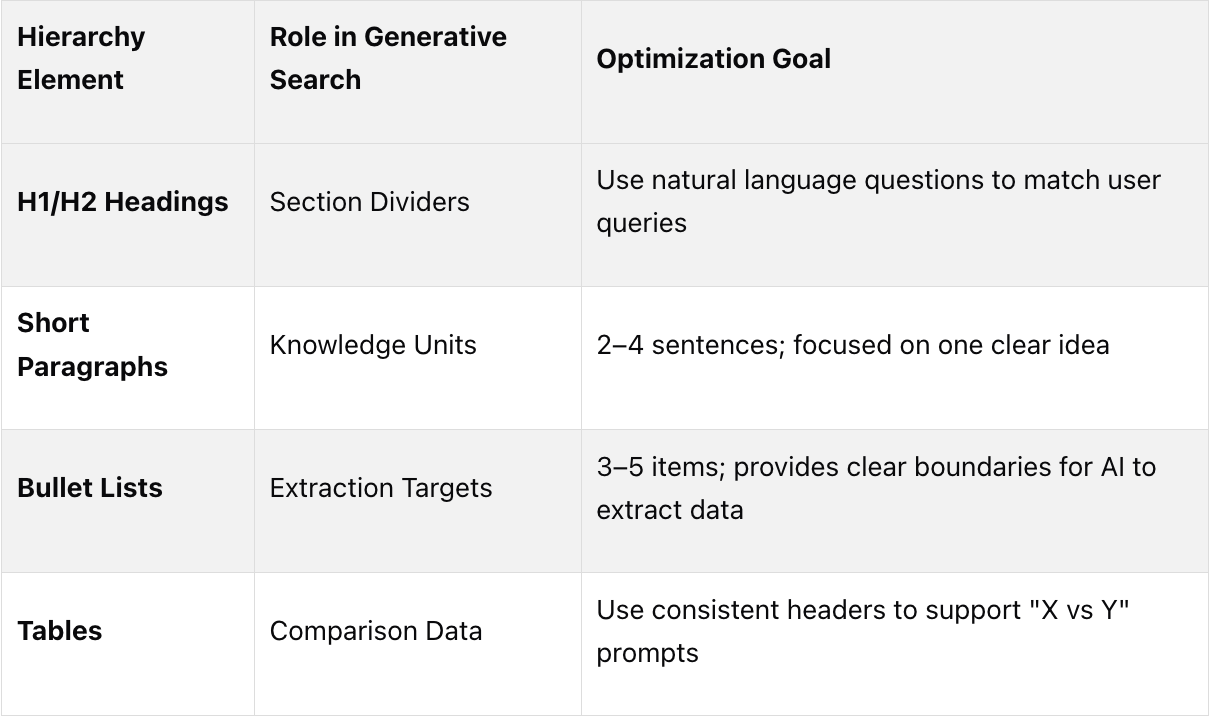
As mentioned earlier, tokenization benefits from a clear H1 → H2 → H3 structure to help AI retrieve specific content [2]. During the "Retrieval" phase of Retrieval-Augmented Generation (RAG), models use this hierarchy to locate relevant information [2]. Breaking content into 100- to 300-word sections focused on single ideas ensures related points stay together [2][6].

Incorporate scannable elements such as bullet lists (3 to 5 items), tables, and FAQ sections to create clear boundaries, making it easier for AI to extract information verbatim [2][7]. Place key insights, definitions, and data at the beginning of sections to ensure they're captured before AI models hit their token limits [2]. As Benu Aggarwal, Founder and President of Milestone Inc., points out:

Heading hierarchy and short paragraphs... guide models to the right passage and reduce the risk of burying key points [2].

Improving Visibility with Data and Structured Elements

When it comes to AI models evaluating your content, they prioritize factual accuracy and specificity. The more precise and verifiable your claims are, the better your chances of being cited. Generative engines rely on Retrieval-Augmented Generation (RAG) to sift through web content, break it into smaller pieces, and synthesize answers. Including distinct, reliable data significantly outshines vague or generalized content [8].

This doesn't mean cramming numbers into your text - it’s about making your claims concrete and easy for machines to process. Pairing hard data with structured markup creates a system that AI can easily extract and verify. This approach transforms your content into a trusted resource that AI engines repeatedly reference [12][13].

Adding Statistics and Citations

Replace ambiguous phrases with precise figures. For example, instead of saying, "our platform is growing fast", opt for, "our platform grew 25% year-over-year." This kind of clarity makes your content more appealing for AI to extract and use [1]. A 2024 Princeton University study found that adding a specific citation to a statement about Swiss chocolate consumption boosted that source's visibility in AI-generated answer snippets by an impressive 132% [1].

The same study, which analyzed over 10,000 queries, revealed that incorporating quotations and statistics increased visibility by 30% to 40% and improved subjective quality scores by 15% to 30% [1]. Linking directly to primary sources, such as datasets, academic papers, or government reports, strengthens your E-E-A-T (Experience, Expertise, Authoritativeness, Trustworthiness) signals [1][4]. AI models tend to prefer sources that either provide unique insights or corroborate claims already supported by other authoritative sites [8][1].

Be assertive when presenting data. Phrasing like "Studies show a 25% increase" carries more weight than "It seems there may be an increase." This kind of direct language signals credibility to AI quality filters and improves your chances of being cited [1].

In addition to using statistics, structuring your data with schema markup further enhances its machine-readability.

Implementing Schema Markup

Schema markup serves as a "translation layer" for your content, helping AI understand the meaning behind your data - whether it’s a price, a date, credentials, or a step-by-step process [12][13]. The preferred format for schema is JSON-LD, which is widely supported by Google and AI crawlers like GPTBot [1][13].

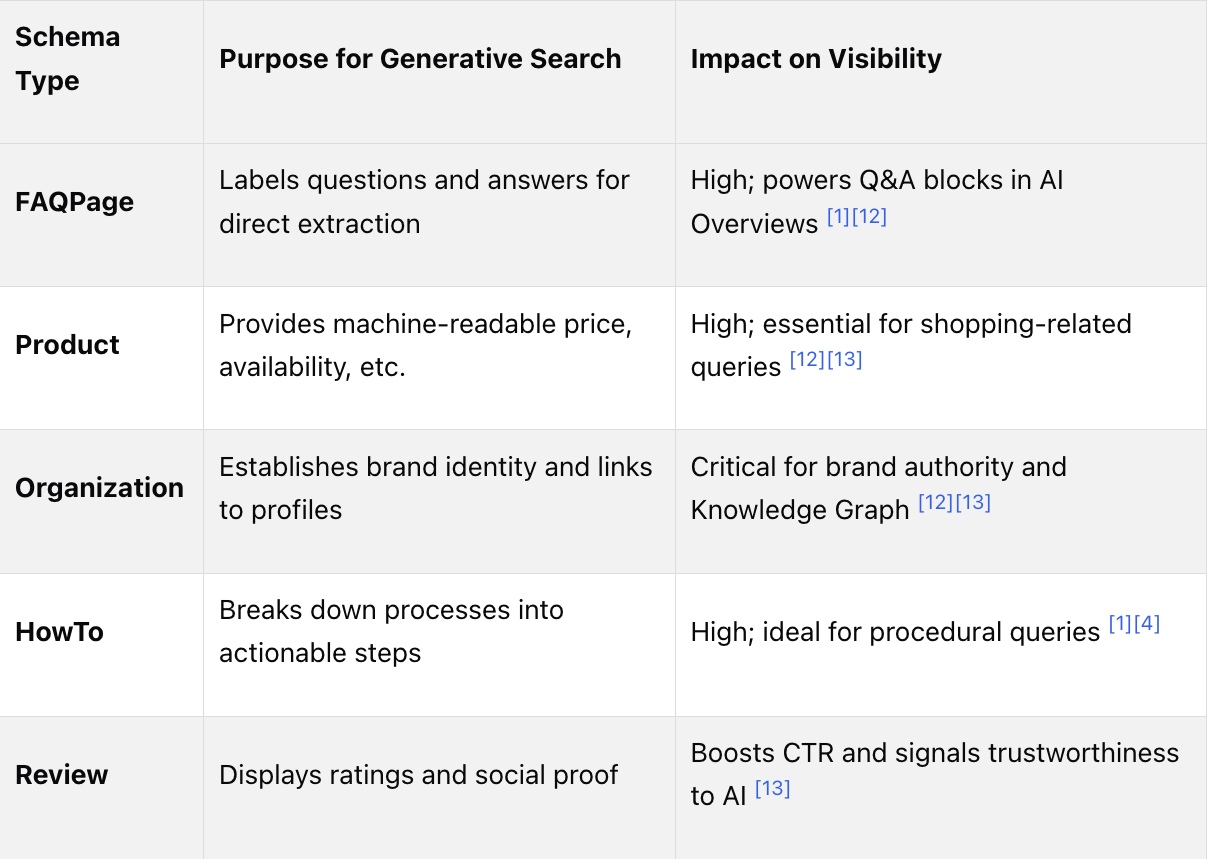
Content that uses multiple schema types sees 2.3 times higher citation rates in AI search results compared to content with only one schema type [8]. Key schema types to focus on include:

  • Organization schema: Establishes brand authority and links to official profiles.
  • Product schema: Details price, availability, and product variants, essential for commercial content.
  • FAQPage and HowTo schemas: Structure answers and step-by-step instructions for better AI extraction.
  • Review schema: Displays ratings and social proof directly in search results.

Jared Bauman, Co-Founder of 201 Creative, explains the importance of schema:

"Schema acts as a clean, machine-readable 'translation' layer for your content, which is critical for large language models to accurately extract and cite information for AI Overviews" [12].

To ensure your schema works as intended, regularly validate it using tools like Google’s Rich Results Test and the Schema Markup Validator. Syntax errors can cause AI to disregard your data entirely, negating any advantage [12]. Also, make sure your robots.txt file allows crawlers like GPTBot, Claude-Web, and PerplexityBot to access your structured data [12].

Content Formats That Work for Generative Search

A clear hierarchical structure is just the beginning - choosing the right content formats can make a world of difference when it comes to AI extraction. AI systems break down content into structured chunks, and formats like lists, comparison tables, and Q&A sections act as helpful signals. These formats guide large language models (LLMs) in identifying, extracting, and summarizing information more effectively [7]. When tools like Retrieval-Augmented Generation (RAG) process your content, structured formats remain intact, ensuring that step-by-step instructions or comparison data aren’t fragmented [8].

Here’s a compelling stat: LLMs reference structured content 28–40% more often [7]. Listicles and comparison-based formats alone make up 32% of all LLM citations [14], and structured, answer-first content is cited three times more than traditional long-form blogs [14].

Creating Scannable Lists and Comparisons

Structured lists and comparisons are powerful tools for making your content both user-friendly and AI-friendly. To maximize clarity, try using layered summaries. Start with a short summary (less than 25 words), follow it with 3–5 key points, and wrap up with a brief explanatory paragraph [4]. This approach gives AI multiple levels of detail to work with, improving its ability to extract meaningful information.

For procedural content, numbered lists are ideal because they preserve the order of steps when AI processes your text. Begin each step with an action verb and keep related details within 200 words to ensure they stay grouped during extraction [8]. For comparison queries like "X vs Y", HTML tables with consistent row headers are particularly effective. Including a clear summary or "verdict" at the end can help AI generate a synthesized answer [15].

When it comes to definition blocks, place a concise 1–2 sentence explanation at the top. FAQ sections also work well but perform best when answers are kept between 40–80 words and use FAQPage schema markup [4][7]. These formats align seamlessly with token-based extraction methods, ensuring your content is optimized for AI processing.

Lite Studio's GEO Structuring Services

With over a decade of experience, Lite Studio specializes in transforming content-heavy websites into streamlined, user-focused designs that cater to both AI systems and human readers. Their "Less is Better" philosophy simplifies complex information into concise, clear content. This approach aligns perfectly with generative search's emphasis on clarity, ensuring key details are easy to access for users and AI algorithms alike. By prioritizing answer-first formatting and a logical content hierarchy, Lite Studio helps clients achieve better visibility in AI-driven search results.

Their process is data-driven and efficient, blending UX research with analytics to guide every design choice. Focusing on platforms like Webflow and Framer, they prioritize key technical elements such as fast loading times, mobile responsiveness, and clean layouts. These strategies not only meet AI extraction standards but also ensure a seamless user experience. Dave Herman from General Indemnity Group shared his experience:

Lite has helped us to completely transform our web presence and SEO results. They are excellent partners and have become a trusted source for us tackling everything from simple to complex website builds and features [16].

Answer Engine Optimization (AEO) Services

Lite Studio has developed proprietary techniques for Answer Engine Optimization (AEO), tailored to improve visibility in AI-driven and voice search platforms. Their approach focuses on preparing businesses for the future of search, which increasingly prioritizes direct answers, natural language headings, and semantically clear content that AI systems can easily interpret and reference.

The importance of AEO is clear. Studies indicate that AI Overviews can reduce traditional click-through rates by about 34.5% [5], making AEO a critical component for maintaining online visibility. For businesses that adapt to these changes, AI search traffic can account for up to 8% of new signups [17], highlighting the tangible benefits of optimizing for this evolving search landscape.

Web Design and Development for Structured Content

Lite Studio integrates AEO principles directly into their web design and development process. Their team creates websites that not only look great but are also technically optimized for AI content extraction. By focusing on structured content frameworks, they ensure that each design element aligns with how large language models (LLMs) and generative search engines process and prioritize information.

Lite Studio offers a streamlined process that can elevate a brand in as little as 30 days [16]. From initial consultation to project completion, they handle planning, design, development, and handoff with precision. Phoebe Myers from A Little Inn on Pleasant Bay praised their work:

Proactive, smart, and responsive, they took the lead and drove content and SEO improvements for our website while we needed to focus on other business priorities [16].

Pricing and Plans

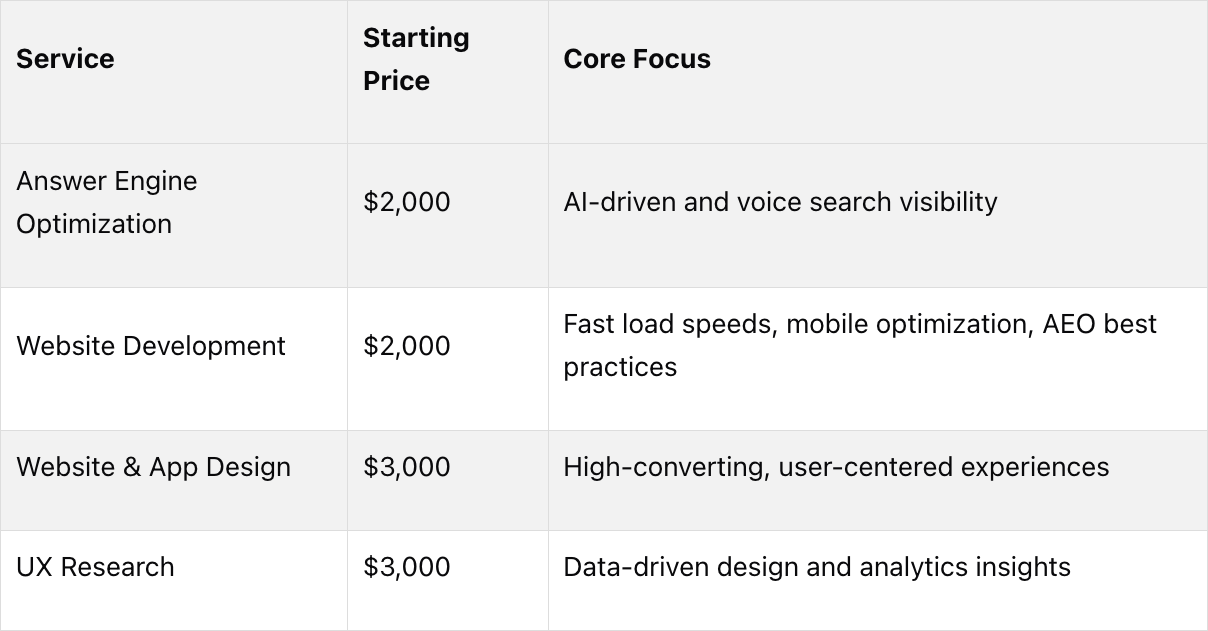
Lite Studio’s pricing is designed to be transparent and scalable, catering to enterprise needs. Their Answer Engine Optimization services start at $2,000, offering proprietary techniques to boost AI search visibility. Website Development also begins at $2,000, featuring Webflow and Framer builds optimized for speed and mobile usability. For businesses seeking comprehensive design solutions, Website and App Design services start at $3,000, including UX research and precise, user-focused layouts. Additionally, their User Experience Research services start at $3,000, providing analytics-based insights to guide strategic design decisions.

Every service combines proven SEO strategies with advanced GEO and AEO techniques, ensuring websites perform well in both traditional search rankings and AI-generated search outputs.

Conclusion: Key Takeaways for Generative Search Optimization

Adapting your content for generative search has become more crucial than ever as AI-driven search continues to reshape the way users interact with digital information. With AI Overviews now appearing in over 54.6% of Google searches [18] and traditional click-through rates dropping by 34.5% when these overviews are present [5], the focus has shifted from simply ranking high to being cited as a trusted source.

To succeed in this evolving landscape, focus on these key strategies: provide direct answers, use query-based headings, organize content into scannable modules, and implement schema markup. Including specific statistics and citations, along with maintaining an authoritative tone, can increase AI-generated visibility by 30–40% and up to 89%, respectively [1]. Furthermore, structured formats like bullet points and clear Q&A blocks make content 28–40% more likely to be cited by large language models (LLMs) [7].

Technical factors also play a significant role. Fast load times and mobile optimization are critical for AI evaluation. Interestingly, nearly 60% of AI citations come from lower-ranking pages that are better structured for generative engines [18], proving that well-organized content can help even smaller players compete effectively.

For businesses looking to implement these strategies, expert services can provide a head start. Lite Studio offers Answer Engine Optimization services starting at $2,000, combining structured content frameworks with proprietary techniques tailored for AI extraction. Their web development services, also starting at $2,000, seamlessly integrate these practices into platforms like Webflow and Framer. With transparent pricing and a track record of transforming content-heavy websites into AI-friendly hubs, Lite Studio helps enterprises stay ahead in the generative search era.

FAQs

Why do question-based headings improve visibility in AI-driven search results?

Using question-based headings like “What is...?” or “How does...?” can significantly improve how AI models interpret and extract answers from your content. These headings clearly define the purpose of each section, making it easier for generative AI to align your content with user search intent. This strategy not only boosts the chances of your page appearing in AI-generated responses but also makes the content more user-friendly.

By breaking information into concise, question-and-answer sections, you enhance readability for both people and AI. This format allows AI to quickly pull relevant snippets without wading through lengthy paragraphs. It also caters to AI’s preference for answer-first experiences, which can improve your visibility in AI-driven search results and voice search.

Lite Studio’s AEO and GEO strategies are designed to help large enterprises refine their content using question-based headings, bullet points, and clear summaries. These techniques ensure that their expertise is effectively highlighted in AI-powered search results across the U.S. market.

How does schema markup improve visibility in generative search results?

Schema markup is a key player in Generative Engine Optimization (GEO), giving AI-driven search engines a clear, structured map of your page’s content. By using formats like JSON-LD and the vocabularies provided by Schema.org, you can tag important details - such as products, FAQs, events, or business information - so generative models can better understand and reference your content.

Think of schema markup as a "cheat sheet" for AI. It helps search engines quickly grasp what your content is about and where it’s located on the page. This boosts the chances of your site being included in AI-generated answers, rather than getting lost in traditional search results. That said, it’s essential to include the same critical information in your visible content, since some models prioritize natural language over structured data.

For businesses managing large or intricate websites, Lite Studio provides customized GEO and AEO services to ensure your schema is implemented accurately and stays in sync with the latest search technologies.

Why should content for AI models include specific statistics and citations?

Including clear statistics and reliable citations can make your content stand out to AI models, which prioritize accurate and trustworthy information. Generative AI systems - like ChatGPT or Google’s Search Generative Experience - are more likely to pull from content that includes well-documented data and authoritative references. This can increase the likelihood of your content being cited in AI-generated responses.

Beyond that, using statistics and citations boosts trustworthiness by signaling reliability to AI ranking systems. When your content is backed by measurable evidence and links to reputable sources, it eliminates ambiguity and positions your material as dependable. For businesses aiming to scale their content effectively, Lite Studio provides tailored services to help meet these benchmarks and enhance visibility in AI-powered search results.

Key Points

What is Answer Engine Optimization (AEO) and how does it differ from traditional SEO?

  • AEO focuses on making your content the go-to source for AI-powered search engines like ChatGPT, Google AI, and Bing Copilot.
  • Traditional SEO aims for high rankings in search results, while AEO ensures your answers are directly cited in AI-generated summaries and voice search responses.
  • Lite Studio’s AEO methodology leverages direct-answer formatting, schema markup, and question-based headings to maximize your business’s authority in the AI search landscape.

Why is direct-answer formatting critical for AI search visibility?

  • AI models extract answers from the first 30–50 words of a section, making answer-first formatting essential for being cited.
  • Placing key insights at the top increases your chances of appearing in AI-generated overviews and featured snippets.
  • Lite Studio’s approach ensures every section starts with a clear, authoritative answer, boosting both human and AI comprehension.

How do question-based headings improve generative search performance?

  • Headings that mirror natural user queries help AI engines map and extract relevant information more effectively.
  • Question-based headings increase the likelihood of your content being selected for People Also Ask (PAA) and AI summary features.
  • Lite Studio crafts headings that align with trending queries, enhancing both discoverability and user engagement.

What role does schema markup play in AI and generative search optimization?

  • Schema markup (e.g., FAQPage, HowTo) makes your content machine-readable, improving extraction accuracy for AI engines.
  • Implementing structured data increases eligibility for rich results and AI-generated answers.
  • Lite Studio validates and implements schema to ensure your content is fully optimized for both traditional and generative search.

How can data and citations increase my content’s authority in AI search?

  • Including specific statistics and authoritative citations can boost your AI citation visibility by up to 40%.
  • AI systems favor content with clear, data-backed claims and direct links to primary sources.
  • Lite Studio integrates reliable data and expert quotes to strengthen your E-E-A-T (Experience, Expertise, Authoritativeness, Trustworthiness) signals.

What ongoing steps should I take to maintain AI search visibility?

  • Regularly update your content with new data, industry trends, and evolving best practices to stay relevant in AI search.
  • Monitor AI citation and featured snippet performance using specialized analytics tools.
  • Lite Studio offers ongoing optimization and reporting, ensuring your business remains a trusted source as AI search evolves.

Get Started

Streamline your online presence and captivate users with a refined, single or minimal page experience. Schedule a call with our team today to discuss how we can simplify your site and elevate your brand in just 30 days.

Schedule Call