"To be generated, you must first be retrieved." – Gianluca Fiorelli, Strategic SEO Consultant [2]
In essence, before AI can recommend or cite content, it must determine that the content is contextually relevant and reliable enough to retrieve from the vast pool of information.
These principles - intent alignment, modularity, and context - push AI systems beyond simple keyword matching, enabling them to deliver meaningful, task-focused solutions.
Task Planning and Execution in AI Search
Once AI systems grasp a user’s intent and context, the next step is turning that understanding into action. This is where task planning and execution come into play - essentially, the process of converting a user’s goal into a completed result.
Breaking Down Complex Tasks
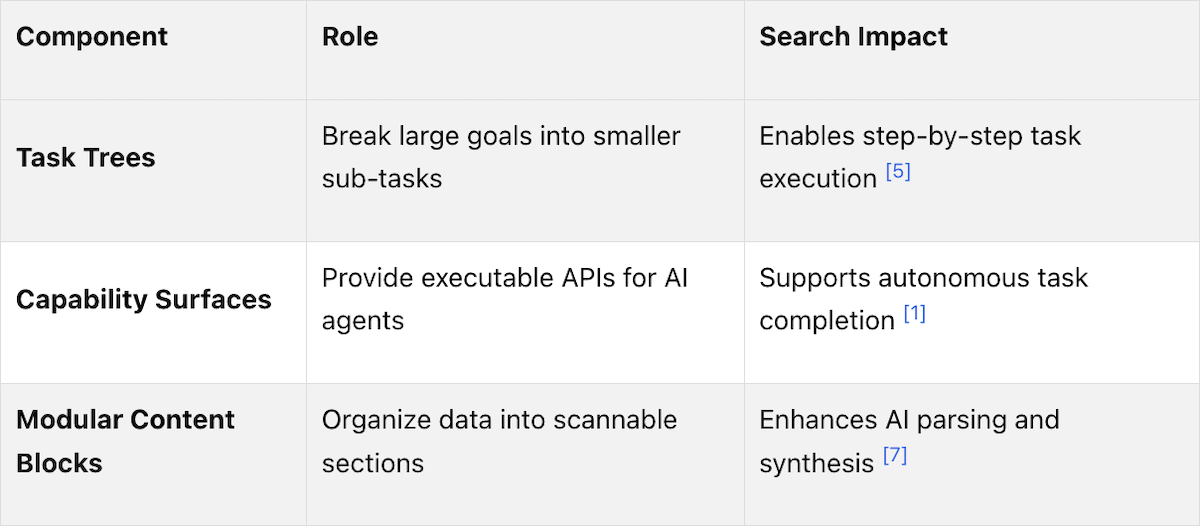
When faced with complicated queries, AI systems simplify the process by breaking tasks into smaller, more manageable steps. Frameworks like AgentOrchestra use a two-tier system: a high-level "Planning Agent" divides long-term objectives into sub-tasks, which are then handled by specialized agents [12]. For instance, sub-goals might involve gathering information, interacting with booking platforms, or analyzing pricing and availability [12]. These specialized roles - such as "Deep Researchers" and "Browser Use Agents" - work together to tackle different aspects of the query [12].
The concept of capability surfaces is key here. Websites are evolving from static pages meant for human browsing into functional platforms that AI agents can interact with directly [1]. For example, a travel site might provide a BookAction API, allowing an agent to book a flight or hotel without needing to navigate through the traditional browse-and-click process. This structured approach paves the way for real-time adaptability, which is explored further in the next section.
Dynamic Query Evaluation
After breaking tasks into smaller parts, AI systems refine their execution by dynamically evaluating live data. This involves query fan-out, where a single prompt generates multiple sub-requests to various data sources [2]. Instead of relying solely on keywords, the system uses semantic fingerprinting to align natural-language queries with user intent [13].
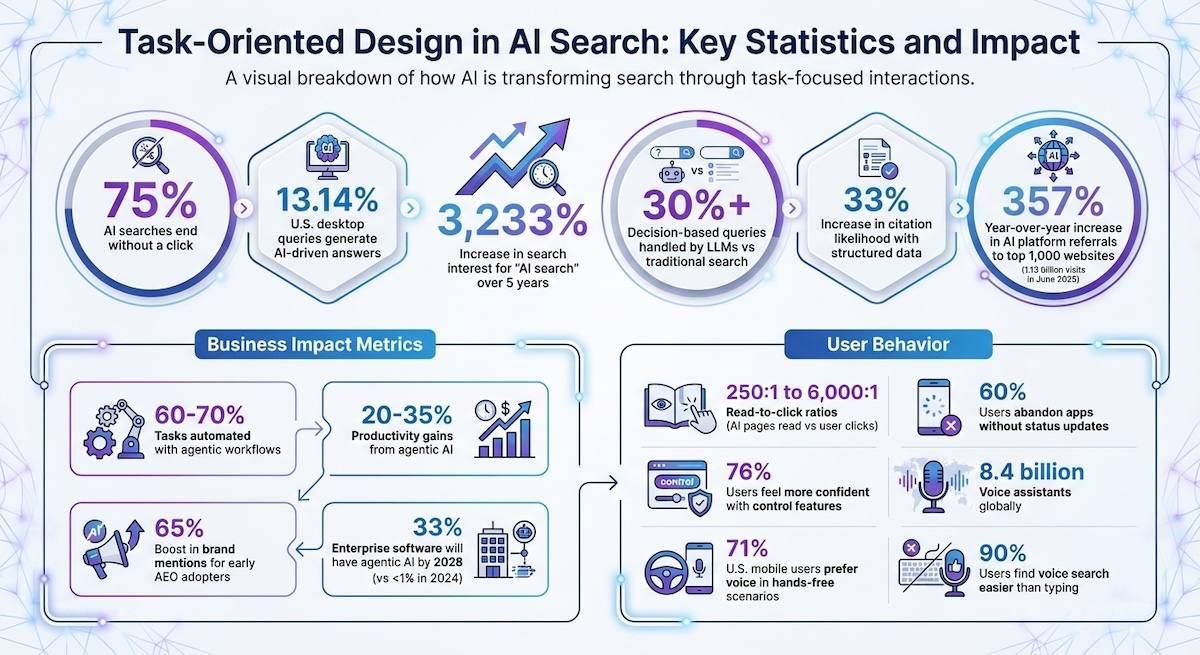
This process creates what’s known as an agentic execution flow. Unlike the traditional search process - where users search, click, read, and then act - the AI autonomously evaluates options and only involves the user for final decisions [1]. With read-to-click ratios between 250:1 and 6,000:1, most of this evaluation happens without user interaction [1]. In fact, about 75% of searches now end without a click, as AI delivers synthesized answers directly within the interface [13].
Real-time trust modeling is crucial in this process. AI agents assess the reliability of data sources by considering factors like cryptographic content signing, verification scores, and the quality of structured data before choosing the best course of action [1].