Lite Studio Webclip

Simplify Your Website. Elevate Your Brand.

Schedule a call with our expert web design and answer engine optimization team today to discuss how we can improve search visibility and upscale your brand's online presence in just 30 days.

Schedule Call

Voice Search Intent: Key Factors

Justin Lundstrom Lite Studio Headshot
Justin Lundstrom
March 6, 2026
Voice search drives 1 billion monthly queries with 3.2x higher purchase intent. Optimize for conversational 29-word queries, local “near me” searches (76%), and Position Zero results across smartphones and smart speakers with Lite Studio’s proven AEO strategies.

Article Summary

What makes voice search intent different from text-based searches?

Voice queries average 29 words compared to 3–4 words for text searches and are 3.2 times more likely to lead to purchases within 24 hours. They use conversational language with question words and reveal user intent more clearly through natural speech patterns.

How important are local searches in voice search behavior?

Voice searches are three times more likely to have local intent than text searches, with 76% including near me components. Additionally, 28% of voice search users call a business immediately after their search, making local optimization critical for driving direct customer actions.

What role do devices play in voice search optimization?

Smartphones dominate on-the-go searches for directions and business hours, while smart speakers handle home tasks like recipes and weather. Since 80% of voice answers come from the top three organic results and 97% from the top ten, device-specific optimization is essential for visibility.

How should businesses structure content for voice search success?

Use conversational question-based headings with concise 40–60 word answers positioned for Featured Snippets. Implement FAQ and LocalBusiness schema markup, ensure fast page speeds, and maintain accurate business information across Google Business Profile, Apple Maps, and Bing Places.

Why is Position Zero critical for voice search optimization?

Voice search operates on a winner-take-all model where there is no Page 2, often only Result 1. With 40.7% of voice answers coming from Featured Snippets and over 1 billion monthly voice searches, securing Position Zero is essential for capturing high-intent traffic that converts at higher rates.

Voice search is reshaping how people find information, with over 1 billion monthly searches and 157.1 million U.S. users projected by 2026. Unlike text-based searches, voice queries are longer, conversational, and often include question words like "who", "what", and "where." These searches reveal user intent more clearly and are 3.2 times more likely to lead to purchases within 24 hours.

Key factors influencing voice search intent:

  • Phrasing: Voice queries are longer (average 29 words) and conversational, often framed as questions.
  • Context: Location, time, and activity impact searches, with 76% including "near me" and 28% leading to direct business calls.
  • Device Usage: Smartphones dominate on-the-go searches, while smart speakers handle home tasks. 80% of voice answers come from the top 3 organic results.

To optimize for voice search:

  • Use conversational, question-based headings and concise answers (40–60 words).
  • Ensure local business details are accurate across platforms.
  • Implement schema markup (e.g., FAQ, LocalBusiness) and improve page speed.

Voice search prioritizes "Position Zero" results, making it critical for businesses to adapt their content for natural language and quick answers.

1. Phrasing in Voice Queries

Intent Influence

How people phrase voice searches often reveals more about their intent than text-based searches. For instance, typing "weather Boston" is a quick, shorthand approach, while saying, "What's the weather like in Boston today?" adds valuable context, making it easier for search engines to interpret the query. This conversational tone is a hallmark of voice searches, with only 13.1% of voice queries overlapping with text-based ones [7]. Voice searches are usually framed as questions, starting with words like "who", "what", "where", "when", "why", or "how" [7]. For example, "What's the best Thai restaurant near me right now?" shows an immediate local need, while "What is the best recipe for a veggie burger?" leans toward seeking information. This detailed phrasing highlights the unique way users interact with voice search.

User Behavior Patterns

Voice search users typically speak in full sentences, averaging about 29 words per query, compared to the 3–4 words often seen in text searches [7]. These longer queries tend to include specifics like time, location, or particular needs. For example, a text search might be "Italian restaurants near me", while the voice equivalent could be, "Hey Siri, can you find an Italian restaurant nearby?" [8]. Regional language differences, such as saying "soda" versus "pop", and an impressive 95% voice recognition accuracy further enhance the local relevance of these searches [2][9]. Interestingly, voice queries are three times more likely to focus on local intent [7]. These patterns provide a roadmap for optimizing content to meet voice search demands.

Optimization Techniques

To align with voice search habits, focus on long-tail, conversational phrases rather than short, fragmented keywords [7]. Structuring content with question-based headings, like "What Is the Best Recipe for a Veggie Burger?" instead of "Best Veggie Burger Recipe", better reflects how people naturally phrase voice queries. Including FAQ sections with concise answers around 29 words can also boost visibility, as 70% of voice search results come from SERP features [8]. Writing in a conversational, 9th-grade reading level style, using contractions and smooth transitions, ensures the content sounds natural when read aloud by voice assistants.

"Marketers should make sure their content is written in a way that can be read aloud." - John Mueller, Search Advocate, Google [12]

2. Contextual Factors

Intent Influence

Where someone is and what they're doing heavily shape how they use voice search. For instance, physical location often triggers "local intent", where users need immediate help finding nearby products or services [1]. A voice query like, "Where can I buy fresh flowers near me that's still open now?" combines urgency, location, and time in a way that’s quite different from simply typing "flower shop" into a search engine. For "near me" queries, voice assistants typically prioritize closer options, but adding terms like "best" might favor higher-rated places, even if they’re farther away [10].

Time and activity also play a big role. Voice searches are especially common during hands-free situations - like driving, cooking, or doing household chores - when users often need quick solutions, such as finding an emergency electrician or checking if a business is open. Smart speakers in kitchens are frequently used for recipes or timers, while in-car systems focus on navigation and business details. Interestingly, about 76% of voice searches include a "near me" component, and 28% of users call a business right after performing a voice search [13].

User Behavior Patterns

Different situations lead to different search habits. When people are on the go - whether driving or walking - they often need immediate, local information. On the other hand, at-home searches tend to focus on informational tasks, like checking the weather or following a recipe step-by-step. Smartphones dominate on-the-go searches, while smart speakers, which lack screens, rely on short, precise spoken answers for at-home queries.

Voice searches are three times more likely to be location-focused than traditional text searches [7]. Most smart speaker users frequently perform local searches, and the typical spoken answer is about 29 words long. It’s also worth noting that different voice assistants pull from different data sources: Google Assistant uses the Google Local Pack, Siri relies on Apple Maps and Yelp, and Alexa sources information from Bing, Yelp, and Yext [10].

Understanding these patterns is key to crafting effective optimization strategies.

Optimization Techniques

To tap into these behavior-driven insights, businesses should focus on optimizing for local intent. Start by ensuring that your business hours are accurate across platforms like Google Business Profile, Bing Places, and Apple Maps [1]. Consistent name, address, and phone (NAP) details across directories are equally important since mismatched information can confuse search algorithms [6]. Adding LocalBusiness schema markup can also help voice assistants recognize your location, service areas, and operating hours.

Incorporate conversational long-tail keywords with phrases like "near me" or "fastest" to improve local search visibility. For mobile users on the go, prioritize fast-loading, mobile-friendly websites to meet their demand for quick, actionable results [9]. At home, focus on creating concise FAQ sections (40–50 words) and structuring content with clear headers and lists to increase the chances of being featured as a voice assistant’s spoken answer [1].

At Lite Studio, we specialize in voice search optimization, tailoring strategies to help businesses enhance their local visibility and engage users more effectively.

3. Device Usage

Intent Influence

The device a person uses for voice search plays a major role in shaping their intent and expectations. For instance, smartphones are the go-to choice for on-the-move scenarios. Did you know that 52% of navigational searches on smartphones are conducted via voice? [6] These searches often involve quick, practical needs like finding directions, checking business hours, or looking up "near me" results while driving or walking. On the other hand, smart speakers at home serve entirely different purposes. They're perfect for tasks like setting timers while cooking, checking the weather while getting ready, or managing smart home devices. Interestingly, 58.6% of U.S. residents have tried voice search at least once [1].

The presence (or absence) of a screen also influences the search experience. Smartphones provide both audio and visual results, letting users explore features like "People Also Ask" or tap on links. In contrast, smart speakers deliver just one answer aloud - a "Position Zero" result. This creates a high-stakes environment where 97% of Google Assistant’s answers come from the top 10 organic results, and 80% from the top three [2]. Screenless devices like the Google Home Mini typically deliver concise answers averaging 41.4 words, while Android smartphones provide slightly longer responses at 43 words [2].

The data sources powering these devices also differ significantly. For example:

  • Google Assistant taps into Google's Knowledge Graph and Local Pack.
  • Siri relies on Apple Maps and Yelp.
  • Alexa pulls from Bing, Yelp, and Yext [11].

These differences matter. Alexa, for instance, struggles with answering about 23% of questions, as it was designed more for shopping and home commands than for general web searches [10]. This device-specific behavior highlights the need to understand how users interact with various platforms.

User Behavior Patterns

How users behave with voice search depends heavily on the device they’re using. Mobile users, for example, are often multitasking - whether driving to an appointment, exploring a shopping area, or even sitting in a restaurant. 58% of voice users search for local businesses on their phones [10], with queries like "Where’s the nearest gas station?" or "Is the pharmacy still open?" These searches are action-focused, and 28% of users call a business immediately after completing a voice search [13].

Meanwhile, smart speaker users at home show different patterns. About 76% of smart speaker owners search for local businesses at least once a week [6]. However, their intent often leans toward gathering information or completing routine tasks - like asking for recipes, checking weather updates, or verifying trivia while their hands are occupied. Voice search is also becoming more common in public spaces like restaurants and gyms, reflecting growing user comfort with the technology beyond home and car settings [16]. Understanding these behaviors is key to tailoring content and strategies for different user scenarios.

Optimization Techniques

To capture voice search traffic across devices, you need a strong technical foundation. Start with fast page speeds and a mobile-first design. Voice search results tend to load much faster than average pages, and 90% of voice results are delivered over HTTPS [2]. Since 70% of voice answers appear in a SERP feature, with 60% being Featured Snippets [2][14], structuring your content to provide a direct, concise 30-word answer below question-based headers can significantly improve your chances of being featured.

Device-specific optimization is equally important. Each assistant has its own preferred platform:

  • For Google Assistant, focus on your Google Business Profile.
  • For Siri, make sure your Apple Maps Connect listing is accurate.
  • For Alexa, keep your Bing Places details up to date [11].

Additionally, implementing Schema markup tailored to each device - like FAQ, How-To, and LocalBusiness types - can help digital assistants better understand and display your content on both smartphones and smart speakers [9][15].

At Lite Studio, we specialize in crafting answer engine optimization (AEO) strategies that ensure your content reaches users no matter where they are - whether they’re asking from their car, their kitchen, or their smartphone.

Voice Search Optimization: The Complete Guide

Pros and Cons

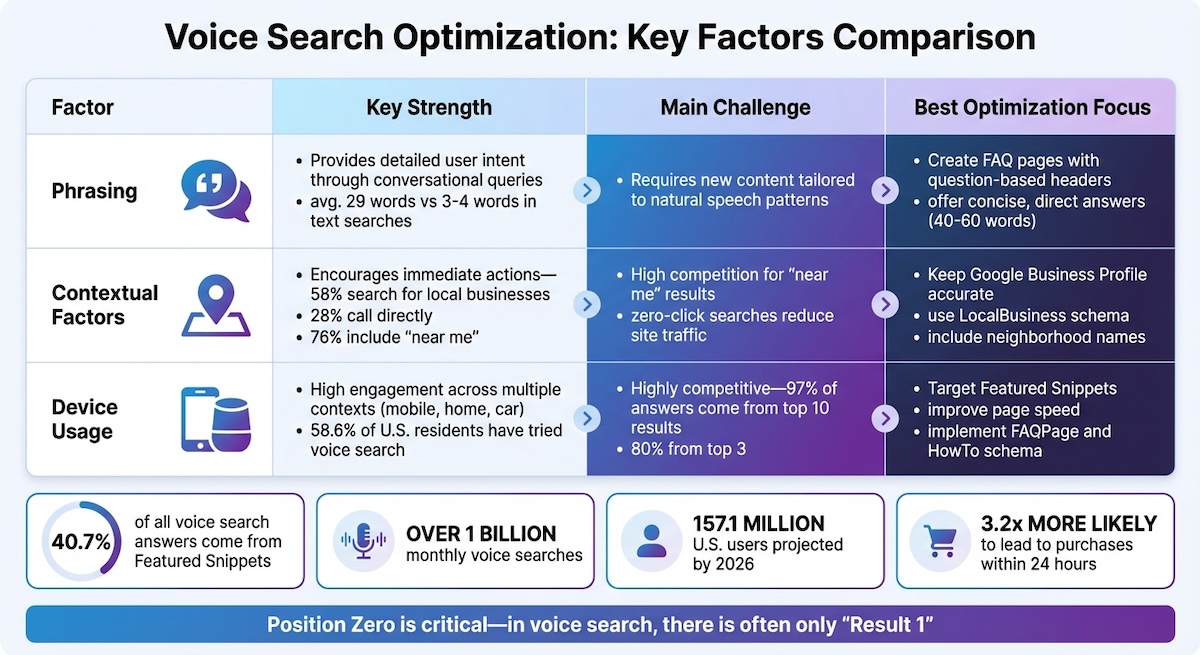
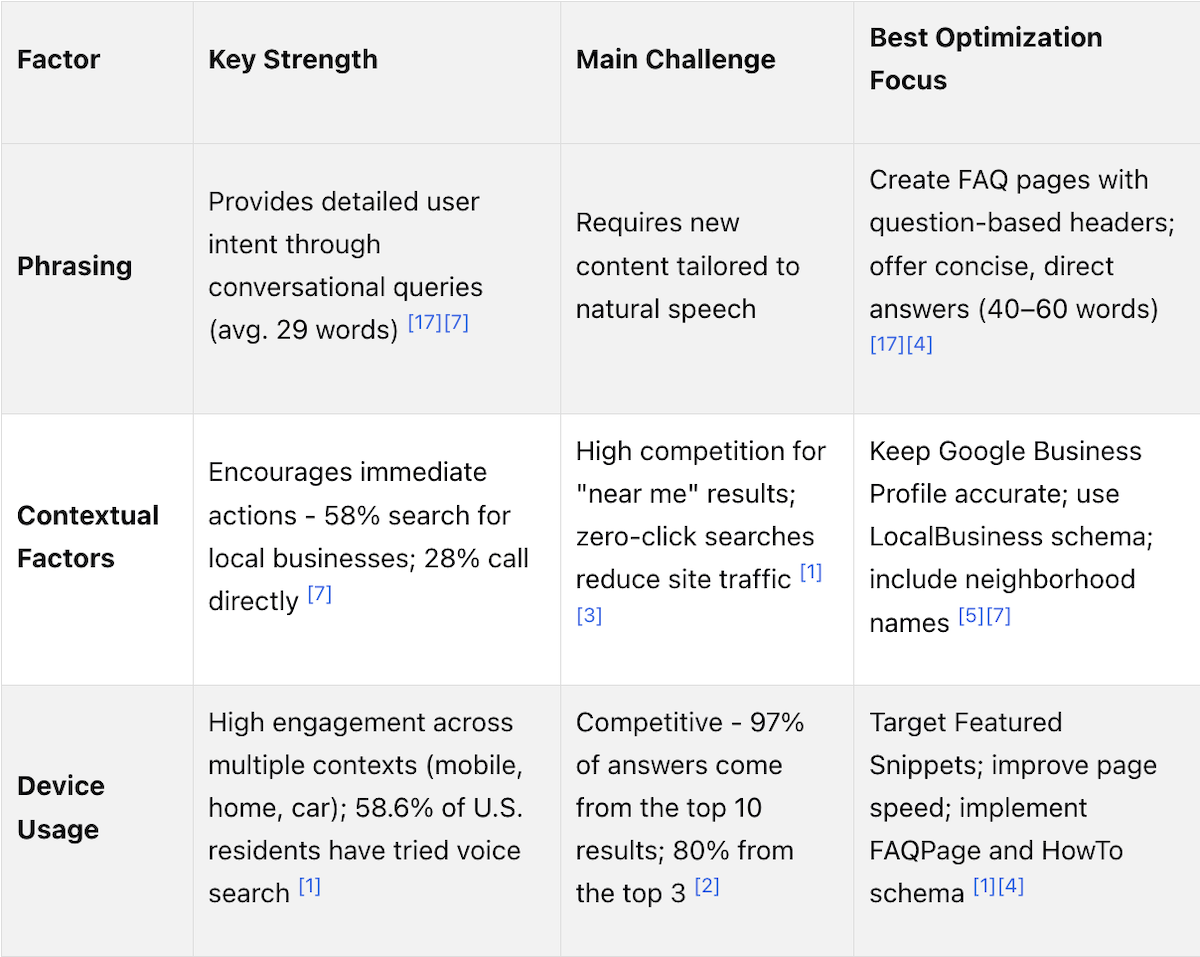
Voice Search Key Factors: Phrasing, Context, and Device Usage Comparison

Let’s take a closer look at the strengths and challenges of key voice search factors, along with actionable strategies to optimize for them.

Phrasing gives a clear insight into user intent. For example, a query like "Where can I buy organic dog food near me right now?" shows immediate purchase intent, compared to a simple "organic dog food" search. Voice queries tend to be much longer - averaging 29 words compared to the 3–4 words typical of text searches [17][7]. This added context helps you understand what users truly need. However, this also means you need to create entirely new content that reflects how people naturally speak, as these queries often differ significantly from text-based searches.

Contextual factors, such as user location, are incredibly useful for attracting high-intent traffic. Voice searches are three times more likely to have local intent, with 28% of users making a call immediately after a search [7]. But this advantage comes with its own challenges: competition for "near me" results is fierce, and the rise of "zero-click" answers means users might get the information they need from a voice assistant without ever visiting your website.

Device usage patterns highlight varying user behaviors but also bring added complexity. For instance, 80% of answers on smart speakers come from the top three organic results [2]. Smartphones, while offering more flexibility with visual results, demand faster loading times and mobile-first performance. Adding to the challenge, different voice assistants pull data from different sources - Siri relies on Apple Maps and Yelp, while Alexa uses Bing, Yelp, and Yext [6].

Here’s a quick summary of each factor's strengths, challenges, and optimization focus:

Currently, 40.7% of all voice search answers come from Featured Snippets [17][7]. Reaching "Position Zero" is the ultimate objective across all these factors. At Lite Studio, we leverage these insights to craft effective answer engine optimization (AEO) strategies, ensuring your content is ready to meet users wherever and however they search.

Conclusion

Voice search is changing the way people find information, leaning on conversational language rather than fragmented keywords. Factors like contextual signals guide users to local business details, while the device being used determines whether the answer is spoken by a smart speaker or displayed on a mobile screen. These shifts demand adjustments in both strategy and technical execution.

Voice search operates on a "winner-take-all" model, as Irina Shvaya, Founder of eSEOspace, explains:

"In the world of voice, there is no 'Page 2.' There is often only 'Result 1.'" [11]

With over 8.4 billion voice assistants in use globally and more than 1 billion voice searches happening each month [7], securing Position Zero is no longer optional - it's essential. Businesses that master conversational language, use contextual signals effectively, and optimize for multiple devices stand the best chance of capturing voice search traffic.

To succeed, focus on creating content tailored for voice interaction. Use natural, conversational language with contractions and straightforward sentences. Develop FAQ pages with question-based headers and short, clear answers (ideally 40–60 words). Implement FAQPage and LocalBusiness schema, keep your Google Business Profile up-to-date, and ensure your site loads in under 2 seconds on mobile devices [11][12].

At Lite Studio, we specialize in answer engine optimization (AEO) to position your content as the go-to source for voice assistants. Starting at $2,000, our AEO services include restructuring your website for machine-readability, adding schema markup, and aligning your content with natural conversational patterns. We help businesses move beyond traditional SEO to secure the single spoken answer that matters most in voice search.

FAQs

What are the best ways for businesses to optimize their content for voice search?

To get your content ready for voice search, focus on crafting material that mirrors natural, conversational language. Incorporate question-based keywords such as "how", "what", or "where", and keep answers short and direct - around 30 words or less. This approach boosts your chances of being featured as a spoken response. Formats like FAQs and how-to guides work particularly well since they align with the way people interact with voice assistants like Siri, Alexa, or Google Assistant.

It's also crucial to ensure your website is mobile-friendly and loads quickly. Since most voice searches happen on smartphones or smart speakers, a fast and responsive site is non-negotiable. Using structured data like FAQ or How-To schema can further help search engines understand and highlight your content.

For local voice searches, consistency is key. Make sure your business’s name, address, and phone number (NAP) are the same across all platforms. Optimize your Google Business Profile and include location-specific keywords, such as "near me" or city names, to capture users looking for local information.

Lite Studio specializes in helping businesses stand out with Answer Engine Optimization (AEO) and Generative Engine Optimization (GEO). Their expertise ensures sleek, user-focused designs that enhance search visibility and prepare your content for voice search success.

How does the type of device influence voice search intent?

The type of device people use plays a big role in how they approach voice search. It influences both the way they phrase their questions and the context of their searches. For instance, smartphones often lead to quick, on-the-go queries like checking the weather or finding a nearby restaurant. On the other hand, smart speakers or other home devices tend to inspire longer, more conversational questions. These are often tied to home-based tasks, such as setting a timer, playing music, or asking for step-by-step recipe instructions.

Recognizing these differences is key when optimizing for voice search. It allows you to create content that aligns with users' specific needs, depending on their device and where they are using it.

Why is ranking in 'Position Zero' important for voice search?

Ranking in Position Zero is crucial for succeeding in voice search because virtual assistants typically pull their spoken answers directly from featured snippets. If your content lands in this coveted spot, it becomes the first - and sometimes the only - response users hear, offering unmatched visibility.

This top position doesn’t just boost your exposure; it also draws in highly motivated users. People using voice search often seek quick, actionable solutions, making Position Zero a prime opportunity to connect with an engaged audience. By tailoring your content to secure this spot, you can stand out in the increasingly competitive, voice-driven search environment.

Key Points

What are the key statistics driving voice search adoption in 2026?

  • 1 billion monthly searches globally with 157.1 million U.S. users projected by 2026
  • 3.2x higher purchase likelihood within 24 hours compared to text-based searches
  • 58.6% of U.S. residents have tried voice search at least once
  • 95% voice recognition accuracy enables precise local and contextual targeting
  • 52% of smartphone navigational searches are conducted via voice commands

How do phrasing patterns impact voice search optimization strategies?

  • 29-word average queries compared to 3–4 words for text searches provide detailed intent
  • Question-based formats using who, what, where, when, why, how reveal specific user needs
  • Only 13.1% overlap between voice and text queries requiring new content approaches
  • Conversational 9th-grade reading level with contractions ensures natural voice assistant delivery
  • Long-tail phrases capture specific user scenarios and local intent patterns

What contextual factors influence voice search user behavior?

  • 76% include "near me" components making local optimization essential for visibility
  • 28% of users call businesses directly after voice searches, driving immediate conversions
  • 3x more likely to have local intent than traditional text-based search queries
  • Hands-free situations like driving, cooking, or household tasks trigger voice search usage
  • Time-sensitive queries combine location, urgency, and business hours for immediate needs

How do device differences affect voice search optimization approaches?

  • Smartphones dominate on-the-go searches for navigation, business hours, and local services
  • Smart speakers handle home tasks like recipes, weather, timers, and smart home control
  • 80% of voice answers come from the top three organic results, emphasizing Position Zero importance
  • 97% of Google Assistant answers source from the top ten organic search results
  • Different data sources: Google uses Local Pack, Siri uses Apple Maps/Yelp, Alexa uses Bing/Yelp

What technical optimizations are essential for voice search success?

  • Schema markup implementation including FAQPage, LocalBusiness, and HowTo structured data
  • 40–60 word concise answers positioned below question-based headers for Featured Snippets
  • Mobile-first design with fast page speeds under 2 seconds for on-the-go users
  • HTTPS delivery for 90% of voice search results ensuring secure, fast content access
  • Consistent NAP details across Google Business Profile, Apple Maps, and Bing Places

How can Lite Studio help businesses dominate voice search results?

  • Answer Engine Optimization (AEO) services starting at $2,000 for complete voice search positioning
  • Schema markup implementation and website restructuring for machine-readable content optimization
  • Conversational content alignment with natural speech patterns targeting Position Zero results
  • Local visibility enhancement across Google, Apple, and Bing platforms for multi-device optimization
  • Featured Snippets targeting to capture 40.7% of voice search answers and drive high-intent traffic

Get Started

Streamline your online presence and captivate users with a refined, single or minimal page experience. Schedule a call with our team today to discuss how we can simplify your site and elevate your brand in just 30 days.

Schedule Call