User Behavior and Search Intent: Voice vs Traditional SEO
Voice search has reshaped how people interact with search engines, presenting businesses with a unique challenge: understanding and optimizing for the distinct behaviors of voice and traditional search users.
How People Use Voice Search
Voice search thrives on natural, conversational language. Instead of typing something like "weather Chicago", users ask, "What's the weather like in Chicago today?" This shift toward full sentences and questions reflects how people naturally speak.
Multitasking is a major driver for voice search. People turn to voice commands when their hands are busy - whether they're cooking, driving, working out, or otherwise occupied. The hands-free convenience makes voice search the go-to option in situations where typing isn’t practical or safe.
Voice queries tend to be more specific and action-oriented. Users often include words like "how", "what", "where", "when", and "why", signaling their need for immediate, actionable answers. For example, instead of typing "pizza near me", a voice query might be, "What's the best pizza place near downtown that's open right now?" These queries are rich in context, reflecting a conversational tone that demands precise responses.
Next, let’s see how this conversational style contrasts with the more keyword-driven approach of traditional search.
How Traditional Search Works
Traditional search focuses on users who type their queries, often relying on shorter, keyword-focused phrases. These users usually start with broad searches and refine their queries based on the results they see. It’s a more exploratory process, where users are willing to sift through multiple pages to find what they need.
Typed queries favor concise, targeted keywords. People strip away unnecessary words, focusing on the essentials. For instance, instead of asking, "Where can I find the best Italian restaurant in my area?" they might type "best Italian restaurant near me" or just "Italian restaurant."
Desktop and mobile browser users tend to have more patience compared to voice search users. They’re more likely to scroll through results, read snippets, and compare options before making a decision. This gives businesses a chance to grab attention through well-crafted meta descriptions, compelling titles, and structured snippets.
Traditional search often involves research and deliberation. Users compare prices, read reviews, and even bookmark pages for later. This creates a longer decision-making process, where businesses must provide detailed, trustworthy content to win over potential customers.
While traditional search leans toward a research-driven approach, voice search is all about immediacy and location-based needs.
Local and Immediate Needs in Voice Search
Voice search is heavily geared toward instant, actionable results. When someone asks, "What's the nearest gas station?" or "Is Target open right now?" they expect precise, real-time answers they can act on immediately. This urgency sets voice search apart from traditional SEO, which often caters to users planning for the future.
"Near me" searches dominate voice queries. These are especially common among mobile users looking for nearby restaurants, stores, or services. The expectation is that the search engine will automatically factor in their current location, saving them the trouble of specifying it.
Time-sensitive queries are another hallmark of voice search. Questions like "What's traffic like on I-95 right now?" or "Which grocery stores are open late tonight?" highlight the need for up-to-the-minute information. Voice search users typically receive one primary answer, creating a high-stakes environment where businesses must aim for featured snippets or position zero to capture this traffic.
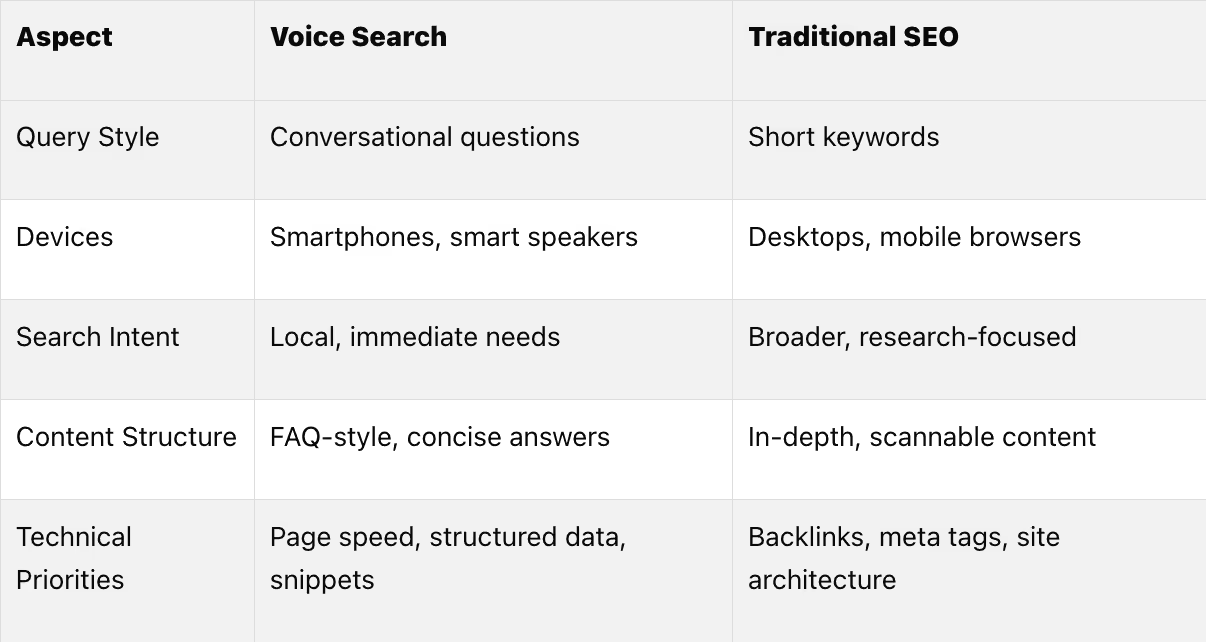
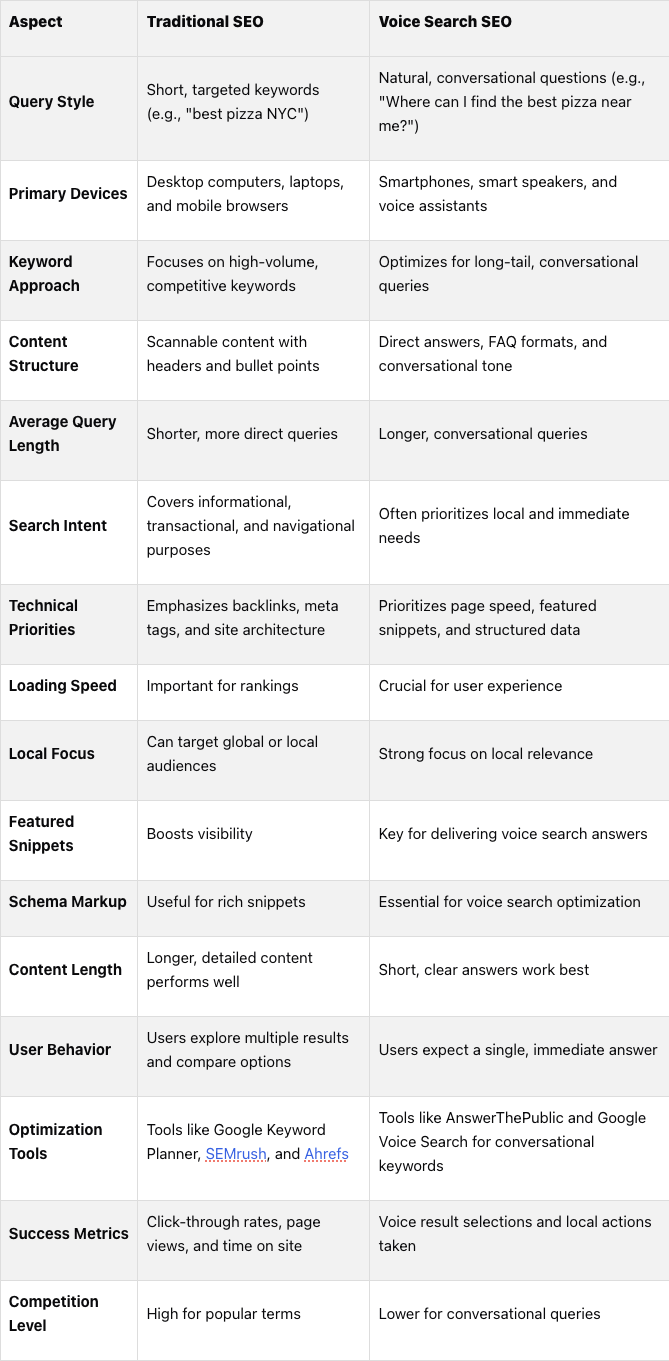
The differences in user behavior between voice and traditional search demand distinct optimization strategies. Voice search prioritizes conversational content, local relevance, and immediate value, while traditional SEO can focus on broader keywords and detailed content that supports users throughout their research journey.