Schedule a call with our expert web design and answer engine optimization team today to discuss how we can improve search visibility and upscale your brand's online presence in just 30 days.
Learn how Answer Engine Optimization (AEO) transforms content for AI-driven search, enhancing visibility and providing direct answers to user queries.
Article Summary
What is Answer Engine Optimization (AEO)?
AEO is the process of structuring content so AI systems—like ChatGPT, Google’s AI Overviews, and voice assistants—can easily extract and deliver direct answers to user questions, rather than just ranking web pages.
How does AEO differ from traditional SEO?
While SEO focuses on ranking pages for keywords to drive clicks, AEO is about providing concise, machine-readable answers that AI can surface directly in search results, often resulting in zero-click experiences.
Why is AEO important for brands today?
As users expect instant, accurate answers from AI-powered platforms, AEO boosts brand visibility and credibility by ensuring your content is cited and featured in these direct responses.
What are the key techniques for effective AEO?
Key techniques include using question-based content, implementing schema markup (like FAQ and HowTo), optimizing for conversational and voice search, and structuring information for easy AI extraction.
What metrics matter most for AEO success?
AEO success is measured by featured snippet wins, voice search share, zero-click impressions, and AI citation rates—metrics that reflect direct answer visibility rather than just website traffic.
Answer Engine Optimization (AEO) is about creating content that AI systems like Siri, Alexa, and ChatGPT can use to directly answer user questions. Unlike SEO, which focuses on ranking whole web pages, AEO ensures your content is structured for quick, conversational responses. With AI-powered tools becoming the go-to for search, businesses need to shift their focus to meet these new demands.
Key Points:
What is AEO? Structuring content for AI to deliver direct answers.
Why it matters: Users now expect instant, accurate answers without visiting websites.
How it helps: Boosts brand visibility and credibility across AI platforms.
Key techniques: Use question-based content, schema markup, and optimize for voice search.
AEO is critical for staying visible as search behavior evolves. Whether it's answering "How do I fix a leaky faucet?" or "What’s the best pizza place nearby?", businesses must adapt to this new way of delivering information.
Enhance for AEO: Lite Studio AEO Tip of the Day
How Answer Engines Work
Answer engines use advanced AI to provide quick, conversational responses. By combining cutting-edge technology with vast amounts of data, these systems are designed to deliver useful answers almost instantly.
AI Technology Behind Answer Engines
At the heart of answer engines are natural language processing (NLP) and large language models (LLMs). NLP helps these systems interpret conversational queries, even when phrased informally or ambiguously. Meanwhile, LLMs, trained on diverse text sources, go beyond simple keyword matching to understand the broader context of a question.
A key innovation in these engines is the use of transformer architecture. This type of neural network excels at identifying relationships between words in a sentence, enabling the system to handle nuanced questions. For example, instead of just matching the words "Italy" and "visit" in the query "What's the best time to visit Italy if I hate crowds?", the engine understands the intent behind the question and provides a tailored response.
Another critical feature is semantic understanding, which allows the engine to grasp what the user truly needs. For instance, when someone asks, "How do I fix a leaky faucet?", the system identifies the request for a step-by-step guide rather than generic information about faucets. This ability to interpret intent is essential for creating responses that are both accurate and relevant.
Query Processing Steps
When a user submits a question, the answer engine follows a series of steps to generate a response:
Query Analysis: The engine breaks down the query to identify key concepts, intent, and context. This ensures it understands not just the words but the purpose behind them.
Information Retrieval and Synthesis: It gathers data from multiple sources, evaluates the credibility of each, and combines insights into a cohesive response. Instead of copying text, it synthesizes information to ensure accuracy and relevance.
Response Generation: Finally, the engine crafts a natural language reply. The response is structured logically, often starting with a direct answer followed by supporting details, all delivered in a conversational tone.
Over time, the system improves by learning from user interactions. This ongoing refinement helps it better understand how people ask questions and what types of answers are most effective.
Common Answer Engine Examples
Answer engines are everywhere, powering tools we use daily. Voice assistants like Amazon Alexa and Apple Siri handle everything from weather updates to cooking tips, evolving to understand more complex, context-based queries. Similarly, AI-driven search tools like ChatGPT, Google’s Bard, and Microsoft’s Bing Chat integrate conversational responses directly into search results, meeting the rising demand for instant, human-like answers.
Smart devices like the Google Nest Hub take this technology a step further by combining voice responses with visual aids. For example, users can get a recipe conversion alongside a chart or video demonstration, blending convenience with clarity.
Even mobile search platforms are embracing answer engines. Features like Google’s featured snippets and Apple’s Spotlight search provide direct answers on the results page, eliminating the need to click through to websites.
What ties all these platforms together is their ability to understand natural language and deliver direct, actionable answers. Instead of just pointing users to possible sources, they focus on providing the exact information users need, right when they need it.
AEO vs Traditional SEO: Key Differences
While both Answer Engine Optimization (AEO) and traditional SEO aim to boost online visibility, they go about it in very different ways. Knowing these differences can help businesses tailor their content strategy to better meet their audience's needs.
Side-by-Side Comparison of AEO and SEO
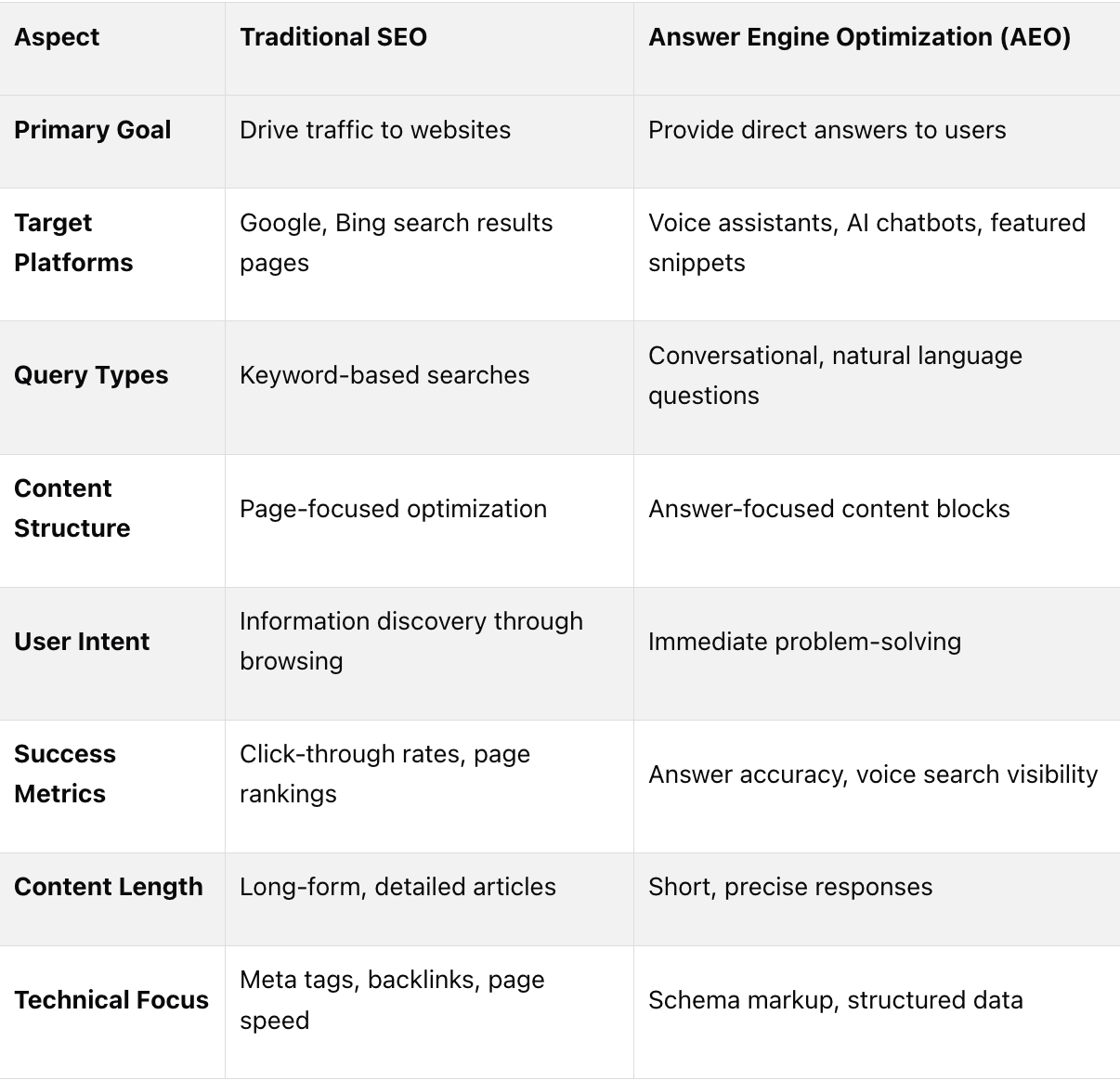
AEO and traditional SEO differ in everything from their goals to the platforms they target and how success is measured. Here's a closer look:
These distinctions highlight how each approach serves a different purpose. Let’s explore how and when to use them effectively.
Traditional SEO focuses on driving traffic by ranking for specific keywords, often by creating in-depth content that spans 1,500 words or more. This type of content is designed to showcase expertise and authority on a subject. AEO, on the other hand, zeroes in on delivering quick, direct answers, often bypassing the need for users to visit a website. It relies heavily on structured data to ensure information is easily accessible to voice assistants and other answer-focused platforms.
When to Use AEO Instead of SEO
Deciding between AEO and SEO depends on your audience and their needs. Here are some scenarios where AEO shines:
Local businesses: AEO is ideal for businesses like restaurants, retail stores, or service providers. For example, when someone asks their voice assistant, "Where's the nearest coffee shop open now?", they want an immediate answer, not a list of websites. Businesses that optimize for these conversational queries are more likely to show up in voice search results.
How-to content: Instructional material works well with AEO. Instead of writing a long blog post on "How to change a car tire", AEO-optimized content can provide concise, step-by-step instructions that a voice assistant can read out loud - perfect for users who are actively working on the task.
FAQ-style content: Questions like "What’s the return policy?" or "How long does shipping take?" are tailor-made for AEO. Structuring your content to answer these queries in a conversational tone makes it more likely to appear in voice search results.
Mobile-first audience: Smartphone users, especially younger demographics, often multitask and prefer quick, spoken answers over lengthy articles. AEO-optimized content caters to this group by delivering immediate, conversational responses.
Time-sensitive queries: Questions about weather, traffic, or business hours require instant answers. AEO is better suited to handle these real-time needs compared to traditional SEO.
That said, traditional SEO still has its place, especially for complex research topics where users want to explore multiple perspectives, dive deep into information, or compare options. Industries like education, B2B, and publishing find significant value in creating comprehensive SEO strategies that engage users over time.
For businesses looking to cover all their bases, a hybrid strategy works best. Use traditional SEO to build brand authority and cover broad topics, while leveraging AEO for quick, actionable answers to common questions. This balanced approach ensures visibility across both traditional search engines and emerging answer-driven platforms, setting the stage for a well-rounded digital strategy.
AEO Implementation Methods
Getting started with Answer Engine Optimization (AEO) calls for a different mindset compared to traditional SEO. It’s all about crafting content that AI systems can easily process, extract, and present as reliable answers. Let’s dive into the key methods businesses should focus on to make AEO work effectively.
Create Content for Direct Answers
For AEO to succeed, your content needs to deliver clear, concise, and accurate answers to user questions. Unlike traditional SEO, which often focuses on keeping users engaged on your site, AEO content should aim to provide complete answers that AI systems can cite directly.
Here’s how to approach it:
Use a question-and-answer format: Organize your content so that questions are clearly stated, followed by precise answers. This makes it easier for AI to extract the information.
Be concise and complete: Avoid fluff. Provide key details like pricing, specifications, or instructions in a straightforward manner.
Structure for easy extraction: Use subheadings, bullet points, or numbered lists to make your content scannable. For example, a step-by-step guide with clear formatting is more likely to be selected by AI than a dense block of text.
Write conversationally: Use natural, everyday language instead of complex jargon. This makes your content more accessible to voice search queries.
Anticipate follow-up questions: If someone asks, “How do I change a tire?” they might also wonder about the tools required, the time it takes, or safety tips. Addressing these related questions increases your chances of being featured in multi-step AI conversations.
These strategies not only make your content user-friendly but also align it with AI systems’ preferences for extracting and presenting information.
Use Schema Markup and Structured Data
Schema markup acts as a bridge between your content and answer engines, helping AI better understand and categorize your information. By using structured data, you’re signaling exactly what your content is about, which increases the likelihood of it being selected as a trusted source.
Some of the most effective schema types for AEO include:
FAQPage, HowTo, and QAPage schemas: These formats clearly define where questions and answers are located on your page. For example, using a HowTo schema for a recipe makes it easier for voice assistants to cite your content when someone asks for cooking instructions.
LocalBusiness schema: Ideal for location-specific queries, like “Where’s the nearest coffee shop?”
Product schema: Useful for e-commerce content, helping search engines display product details like pricing and availability.
Article schema: Great for informational content, signaling its structure and relevance.
To ensure accuracy, your schema markup should match your visible content. If you label something as a “question” in your schema, it should actually appear as a question on your page. Consistency is critical for building trust with AI systems.
Don’t forget to test your schema markup regularly. Tools like Google’s Rich Results Test can help verify that your structured data is implemented correctly and recognized by search engines.
Voice Search Optimization Techniques
Voice search is changing how people interact with content. Unlike typed searches, voice queries are often longer, conversational, and phrased as complete questions. To adapt, your content needs to reflect these patterns.
Here’s how to optimize for voice search:
Mirror natural speech: Instead of targeting keywords like “best pizza NYC,” focus on conversational phrases like “Where can I find the best pizza in New York City?” or “What’s the top-rated pizza place nearby?”
Address local intent: Many voice searches are location-based, so include references to specific areas, landmarks, or neighborhoods in your content.
Provide quick answers: Voice search users often want immediate solutions. Make sure your content delivers essential information upfront, with additional details available for those who want more.
Structure for audio clarity: Since voice search results are often read aloud, your content should be easy to understand without relying on visuals or complex formatting.
Use question-based headings: Organize your content around the actual questions people ask, like “How long does it take to bake a cake?” or “What’s the best way to clean a grill?” These headings align perfectly with voice queries and help AI match your content to user needs.
With over 50% of searches expected to be voice-based or AI-driven by 2025[1], aligning your content with voice search habits is no longer optional. It’s a critical step to staying visible in an evolving search landscape.
AEO Tools and Services
Achieving effective Answer Engine Optimization (AEO) demands a mix of technical know-how, strategic foresight, and the right tools. While some businesses try to manage AEO internally, partnering with seasoned experts often speeds up results and ensures content aligns with the constantly evolving standards of AI-driven search platforms. Below, we’ll explore Lite Studio's approach, features, and pricing, showcasing how their services build on established AEO strategies.
Lite Studio's AEO Services Overview
Lite Studio's data-driven methodology ensures that every decision is rooted in research, tailored to the specific needs of a client’s industry, audience, and competitive environment.
Lite Studio's Service Features
Lite Studio integrates AEO services seamlessly with their web development and design expertise. Their team, proficient in WebflowandFramerdevelopment, incorporates AEO principles directly into the website creation process.
Mobile optimization is a cornerstone of their strategy, ensuring websites not only load quickly but also display flawlessly across all devices - an essential factor for voice search success.
They also emphasize fast load speeds, implementing technical solutions that allow answer engines to efficiently access and process website content.
A strong focus on UX research enables their team to analyze user interactions across platforms. This data informs decisions about content structure and design, ensuring layouts are intuitive for both human visitors and AI systems.
Lite Studio’s design philosophy prioritizes clean, minimal layouts that eliminate unnecessary clutter, resulting in user-friendly websites optimized for AI-driven search.
AEO Service Pricing
Lite Studio offers clear and flexible pricing to accommodate businesses of various sizes and needs.
Website Development Webflow and Framer development, mobile optimization, fast load speeds.
Website and App Design Professional design, UX research integration, pixel-perfect layouts.
User Experience Research Analytics insights, expert observation, best practice recommendations.
The AEO service focuses on optimizing websites for AI-driven search platforms using Lite Studio’s proprietary techniques. For businesses seeking a more comprehensive solution, Lite Studio often combines AEO with website development or UX research, ensuring optimization is integrated into the very foundation of the website.
These prices reflect the specialized nature of AEO work and Lite Studio's dedication to delivering lasting results and value.
Conclusion
Answer Engine Optimization (AEO) is reshaping the way businesses approach online visibility. With AI-driven tools like search and voice assistants becoming dominant, sticking to traditional SEO methods simply won’t cut it anymore.
Main Points Summary
AEO takes a different approach from traditional SEO, focusing on delivering direct, conversational answers rather than relying solely on keyword-heavy strategies. To succeed, your content needs to be structured for quick, precise answers, incorporate schema markup, and be optimized for voice search. This shift demands a fresh perspective on how to craft your digital strategy.
Technical optimization is a cornerstone of AEO. Fast-loading pages, mobile-friendly designs, and clean website architecture are critical for enabling answer engines to crawl and process your content effectively. Even the best content can go unnoticed without these technical elements in place.
Content strategy must adapt to meet the demands of conversational and natural language searches. Crafting content in a question-and-answer format while maintaining authority and expertise is key to standing out in this new search landscape.
By combining technical optimization with a conversational content approach, businesses can secure their place in an AI-driven search environment.
Getting Started with AEO
The first step is to assess your current digital presence. Evaluate your website’s performance in voice search and identify areas where your strategy might fall short. This evaluation will help you pinpoint the adjustments needed to align with AEO principles.
Transitioning to AEO requires both strategic planning and technical expertise. Many businesses find it challenging to juggle their existing SEO efforts with the demands of AEO, which can lead to fragmented strategies and missed opportunities.
Lite Studio offers a solution by integrating AEO into website design. Their research-based approach ensures that optimization efforts are tailored to your industry and competitive landscape, rather than relying on generic guidelines that might not fit your specific needs.
Investing in professional AEO services reflects the specialized skills and knowledge required to thrive in this evolving digital landscape. As answer engines continue to refine their algorithms, businesses that establish a strong AEO foundation now will be better equipped to maintain their visibility and attract customers in an increasingly AI-driven world.
FAQs
How can businesses optimize their content for voice assistants like Siri and Alexa?
To make your content stand out for voice assistants like Siri and Alexa, focus on natural, conversational keywords that mirror how people typically ask questions. Think about the kind of queries users might voice and create content that provides clear, straightforward answers.
Using schema markup is another smart move - it helps search engines interpret your content more effectively. Pair this with a strong focus on local SEO to boost your chances of appearing in location-specific searches. Also, don’t overlook the importance of a mobile-friendly website with fast loading times and support for voice-activated features. These elements not only improve user experience but also help with search rankings.
What are the key benefits of using schema markup for Answer Engine Optimization (AEO)?
Schema markup acts like a translator for search engines, helping them better understand your content. When you add structured data to your site, it increases the chances of your content showing up as rich snippets, featured answers, or other enhanced formats in search results.
These enhanced results don't just make your content more visible - they also grab attention, which can lead to higher click-through rates. Plus, schema markup ensures your website stays in tune with evolving trends like voice search and AI-driven queries, making your content ready for the way people search today.
How does Answer Engine Optimization (AEO) benefit local businesses compared to traditional SEO?
Answer Engine Optimization (AEO) is a game-changer for local businesses, especially when it comes to targeting voice searches and conversational queries. These types of searches are often tied to specific locations, making them crucial for businesses that rely on local customers.
Unlike traditional SEO, which focuses on ranking for general keywords, AEO is all about delivering quick, precise answers to users' immediate questions. This is particularly useful for people searching on the go with mobile devices or smart assistants.
By implementing tools like schema markup and tailoring content to match local search intent, businesses can boost their visibility in voice and AI-driven search results. This not only helps draw more foot traffic but also enhances customer interactions and drives local sales by meeting the needs of users looking for fast, nearby solutions.
Key Points
What advanced schema markup strategies maximize AEO performance?
Implement FAQPage, HowTo, Article, and Organization schema using JSON-LD for clean, machine-readable data.
Use semantic HTML and structured CMS fields to organize FAQs, testimonials, and service details.
Automate schema deployment with plugins or tag managers for consistent, scalable updates.
Validate markup with Google’s Rich Results Test to ensure AI can extract key information.
How do prompt-driven content and conversational queries improve AI search visibility?
Structure content around natural, question-based prompts that mirror how users interact with AI tools.
Use clear, direct answers in the first 40–60 words of each section to increase snippet eligibility.
Incorporate comparison tables, bullet lists, and concise summaries for easy AI extraction.
Regularly update content to reflect evolving user prompts and trending questions.
What distinguishes AEO from SEO in terms of technical implementation and user targeting?
AEO prioritizes schema markup, semantic HTML, and answer-first formatting for AI comprehension.
SEO focuses on meta tags, backlinks, and keyword density for human-driven search rankings.
AEO targets conversational, voice, and zero-click queries; SEO targets text-based, keyword-centric searches.
Both approaches are complementary—AEO ensures AI visibility, while SEO maintains traditional search presence.
How can businesses track and measure the impact of AEO strategies?
Monitor featured snippet appearances, voice search share, and AI citation rates using tools like Semrush and GA4.
Track generative traffic from LLMs (e.g., ChatGPT, Perplexity) with custom UTMs and analytics dashboards.
Analyze conversion rates and engagement metrics from AI-sourced visitors to assess lead quality and business impact.
Use performance data to refine content structure and schema deployment for ongoing improvement.
What real-world results have businesses achieved by implementing AEO, and what best practices drive these outcomes?
Early AEO adopters report up to 10% of organic traffic from LLMs, with 27% of that traffic converting to sales-qualified leads.
AI-sourced visitors show 30% higher average time on site and faster decision-making.
Best practices include restructuring content for LLM discoverability, using clean code platforms (like Webflow), and aligning with prompt-driven search behaviors.
Consistent schema markup and answer-first content drive higher AI citation and brand authority.
How does Lite Studio’s approach exemplify advanced AEO implementation?
Lite Studio restructures client content for semantic clarity and prompt-readiness, ensuring AI engines can easily extract and cite answers.
They leverage Webflow for clean, semantic code and automate schema deployment for scalability.
Their strategy includes creating dedicated LLM info pages and tracking AI-driven traffic to demonstrate ROI.
This approach results in higher AI citation rates, improved lead quality, and a competitive edge in AI-powered search environments.
Get Started
Streamline your online presence and captivate users with a refined, single or minimal page experience. Schedule a call with our team today to discuss how we can simplify your site and elevate your brand in just 30 days.